






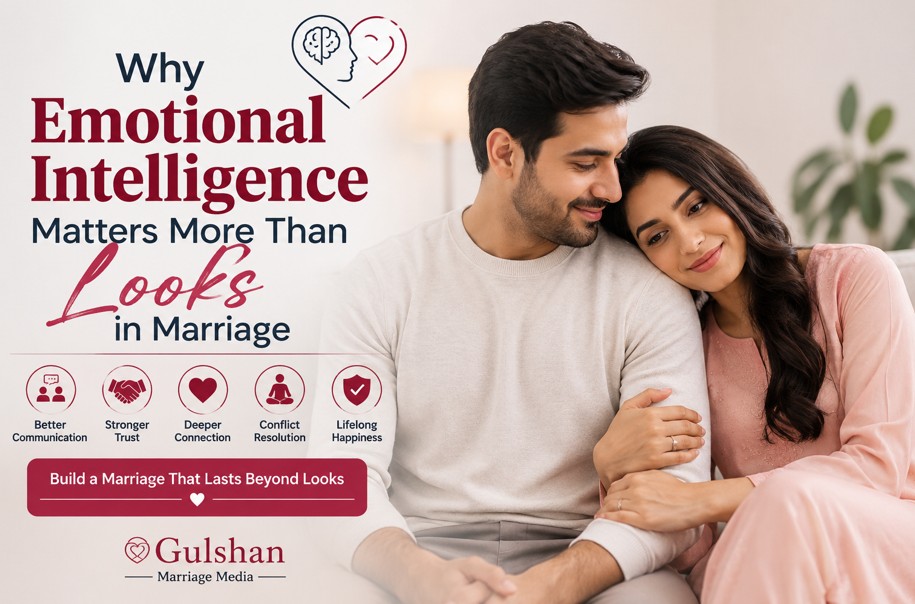
Why Emotional Intelligence Matters More Than Looks in Marriage

Introduction
In a world dominated by social media, filtered photographs, and carefully curated online profiles, physical appearance often receives more attention than ever before. Many people searching for a life partner are naturally drawn to beauty, attractiveness, and outward charm. While physical attraction is an important component of romantic relationships, it is not the factor that determines whether a marriage will thrive for decades.
A successful marriage is built on much deeper foundations than appearance alone. Over time, beauty changes, fashion trends evolve, and physical characteristics naturally transform. What remains constant and continues to influence the quality of a relationship is a person’s emotional intelligence.
Emotional intelligence, often referred to as EQ (Emotional Quotient), is the ability to understand, manage, express, and respond to emotions effectively. It affects how couples communicate, resolve conflicts, support each other, and navigate life’s challenges together.
At Gulshan Marriage Media, we have observed that couples who possess strong emotional intelligence often build stronger, healthier, and longer-lasting marriages compared to those who focus primarily on physical attraction. While looks may spark initial interest, emotional intelligence is what sustains love, trust, and companionship over the years.
This article explores why emotional intelligence matters more than looks in marriage and how it contributes to long-term relationship success.
Understanding Emotional Intelligence
Before discussing its importance in marriage, it is essential to understand what emotional intelligence actually means.
Psychologists generally describe emotional intelligence through five major components:
- Self-Awareness
The ability to recognize and understand your own emotions.
A self-aware person knows:
- Why they feel upset
- What triggers their reactions
- How their emotions affect others
- Self-Regulation
The ability to control emotional reactions instead of acting impulsively.
Examples include:
- Staying calm during arguments
- Avoiding hurtful words
- Managing anger effectively
- Empathy
The ability to understand and share another person’s feelings.
Empathetic partners can:
- Understand their spouse’s perspective
- Offer emotional support
- Build deeper emotional connections
- Social Skills
The ability to communicate and interact effectively.
Strong social skills help couples:
- Discuss difficult topics
- Resolve misunderstandings
- Strengthen intimacy
- Motivation
Emotionally intelligent individuals often have internal motivation to improve themselves and their relationships.
These qualities collectively create healthier and more satisfying marriages.
Why Looks Attract but Emotional Intelligence Sustains
Physical attraction plays an undeniable role in bringing two people together.
Most relationships begin because:
- Someone finds another person attractive.
- They appreciate their appearance.
- They feel chemistry.
However, marriage is not a short-term interaction.
Marriage involves:
- Financial challenges
- Family responsibilities
- Career pressures
- Health concerns
- Raising children
- Personal growth
Attractive looks cannot solve these challenges.
Emotional intelligence can.
When couples face difficult moments, they rely on:
- Communication
- Understanding
- Patience
- Respect
These are all products of emotional intelligence rather than physical appearance.
Beauty Changes, Character Endures
One of the strongest arguments for prioritizing emotional intelligence is that physical beauty is temporary.
Over time:
- People age
- Hair changes
- Skin changes
- Health conditions arise
The qualities that initially attracted someone physically may naturally evolve.
However:
- Kindness remains valuable.
- Compassion remains attractive.
- Emotional maturity remains powerful.
Many couples who have been happily married for decades often say they love their spouse more today than when they first met.
Why?
Because emotional bonds become stronger than physical attraction.
The deeper connection grows through:
- Shared experiences
- Mutual support
- Emotional understanding
These elements are rooted in emotional intelligence.
Emotional Intelligence Creates Better Communication
Communication is often described as the foundation of marriage.
Most marital problems stem from communication failures rather than appearance-related issues.
Consider two scenarios.
Scenario One
A spouse comes home stressed after work.
An emotionally unintelligent partner might:
- Ignore them
- Criticize them
- Start an argument
Scenario Two
An emotionally intelligent partner might:
- Notice their stress
- Ask how they feel
- Offer support
The difference is significant.
Good communication helps couples:
- Feel heard
- Feel respected
- Feel valued
Without emotional intelligence, communication quickly becomes destructive.
Conflict Resolution Depends on Emotional Intelligence
Every marriage experiences conflict.
The question is not whether disagreements occur.
The real question is:
How do couples handle them?
Emotionally intelligent spouses:
- Listen carefully
- Avoid personal attacks
- Seek solutions
- Respect differing opinions
Emotionally immature spouses often:
- Blame each other
- Shout
- Hold grudges
- Refuse compromise
Research consistently shows that successful marriages are not conflict-free.
Instead, successful couples know how to manage conflict effectively.
This skill comes from emotional intelligence.
Emotional Intelligence Builds Trust
Trust is one of the most valuable assets in marriage.
Trust develops when partners:
- Keep promises
- Respect boundaries
- Communicate honestly
- Show consistency
Emotionally intelligent people understand the importance of trust.
They recognize how their actions affect their spouse’s emotional security.
Without trust:
- Suspicion grows
- Anxiety increases
- Intimacy declines
Physical beauty cannot repair broken trust.
Emotional maturity often can.
Empathy Creates Emotional Safety
Many people underestimate the importance of emotional safety in marriage.
Emotional safety means:
- Feeling accepted
- Feeling understood
- Feeling comfortable expressing emotions
Empathy is central to creating this environment.
When a spouse says:
“I’m having a difficult day.”
An empathetic response might be:
“I’m sorry you’re struggling. Tell me what happened.”
A non-empathetic response might be:
“Everyone has problems.”
The first response strengthens the relationship.
The second weakens it.
Over years of marriage, these interactions accumulate and significantly impact marital satisfaction.
Emotional Intelligence Helps During Financial Challenges
Financial stress is among the leading causes of marital conflict.
Unexpected expenses, job loss, business difficulties, and debt can create tension.
Emotionally intelligent couples typically:
- Discuss financial concerns calmly
- Work together on solutions
- Avoid blame
Less emotionally intelligent couples may:
- Accuse each other
- Hide financial information
- Escalate conflicts
Money problems become manageable when couples approach them as a team.
That teamwork depends heavily on emotional intelligence.
Parenting Requires Emotional Intelligence
For couples planning to have children, emotional intelligence becomes even more important.
Children learn emotional behavior from parents.
Emotionally intelligent parents:
- Model healthy communication
- Teach empathy
- Handle discipline appropriately
When parents lack emotional intelligence:
- Household stress increases
- Children may develop emotional difficulties
- Family relationships suffer
A beautiful face does not automatically create a nurturing environment.
Emotional intelligence does.
Emotional Intelligence Strengthens Intimacy
True intimacy extends beyond physical attraction.
It includes:
- Emotional connection
- Vulnerability
- Trust
- Understanding
Many couples experience declining intimacy because they fail to connect emotionally.
Emotionally intelligent spouses make efforts to:
- Understand each other’s needs
- Express affection
- Maintain emotional closeness
The strongest marriages often involve partners who feel emotionally connected even after many years together.
The Problem with Prioritizing Looks Alone
Many individuals make the mistake of evaluating marriage prospects primarily based on appearance.
While attraction matters, overemphasizing beauty can create problems.
Unrealistic Expectations
People may expect perfection.
No one can maintain flawless appearances forever.
Ignoring Character
Important qualities may be overlooked:
- Integrity
- Responsibility
- Compassion
Superficial Connections
Relationships based primarily on looks often lack deeper foundations.
When challenges arise, these relationships can struggle.
Signs of High Emotional Intelligence in a Potential Spouse
When evaluating a marriage prospect, look for these indicators.
They Listen Carefully
They pay attention when others speak.
They do not constantly interrupt.
They Accept Responsibility
Instead of blaming others, they acknowledge mistakes.
They Stay Calm Under Pressure
They manage stress effectively.
They Show Empathy
They care about others’ feelings.
They Communicate Clearly
They express thoughts respectfully.
They Respect Boundaries
They understand personal limits and privacy.
They Value Growth
They continuously seek self-improvement.
These traits often predict marital success more accurately than physical attractiveness.
Real-Life Marriage Situations Where Emotional Intelligence Matters
Caring for an Ill Spouse
When health problems arise, emotional support becomes essential.
Patience and compassion matter far more than appearance.
Managing Family Relationships
In-laws and extended family can create complex situations.
Emotionally intelligent spouses handle these dynamics diplomatically.
Handling Career Changes
Promotions, relocations, and career setbacks require adaptability.
Emotionally mature couples navigate these transitions together.
Coping with Loss
Life inevitably includes grief and hardship.
Emotional intelligence enables couples to support each other through difficult times.
Why Emotional Intelligence Increases Long-Term Happiness
Research consistently suggests that emotional intelligence contributes significantly to relationship satisfaction.
Emotionally intelligent individuals tend to:
- Experience fewer destructive conflicts
- Build stronger relationships
- Feel more satisfied in marriage
- Maintain healthier emotional connections
These outcomes directly influence long-term happiness.
Physical appearance alone cannot provide these benefits.
How to Develop Emotional Intelligence Before Marriage
The good news is that emotional intelligence is not fixed.
It can be improved.
Practice Self-Reflection
Regularly examine your emotions and reactions.
Improve Listening Skills
Focus on understanding before responding.
Learn Conflict Management
Approach disagreements constructively.
Develop Empathy
Try to see situations from another person’s perspective.
Manage Stress
Use healthy coping strategies.
Seek Feedback
Ask trusted friends and family members for honest input.
Growth in emotional intelligence benefits every relationship.
What Marriage Media Professionals Observe
Professional matchmakers often notice a common pattern.
People initially ask about:
- Height
- Weight
- Appearance
- Profession
These factors are understandable.
However, the happiest couples frequently share qualities such as:
- Mutual respect
- Emotional maturity
- Effective communication
- Shared values
At Gulshan Marriage Media, many successful matches demonstrate that emotional compatibility often predicts long-term success better than physical attractiveness alone.
Couples who understand each other’s emotions tend to build stronger partnerships and overcome challenges more effectively.
Emotional Intelligence and Compatibility
Compatibility is often misunderstood.
Many people assume compatibility means:
- Similar hobbies
- Similar tastes
- Similar lifestyles
While these factors help, emotional compatibility is often more important.
Emotionally compatible couples:
- Understand each other’s communication styles
- Respect emotional needs
- Resolve disagreements constructively
This creates stability and harmony throughout marriage.
The Future of Marriage: Emotional Skills Matter More Than Ever
Modern marriages face unique pressures.
These include:
- Social media influence
- Career competition
- Economic uncertainty
- Increased stress levels
As life becomes more complex, emotional intelligence becomes increasingly valuable.
Couples who can:
- Communicate openly
- Support each other emotionally
- Adapt to change
are more likely to thrive.
The future of successful marriage belongs not necessarily to the most attractive individuals but to those who possess emotional maturity and relational wisdom.
The Role of Emotional Intelligence in Building Mutual Respect

One of the most important pillars of a successful marriage is mutual respect. Without respect, even the strongest physical attraction can gradually fade into frustration and disappointment. Emotional intelligence plays a vital role in helping couples maintain respect for one another throughout their married life.
Emotionally intelligent individuals understand that every person has unique thoughts, feelings, and experiences. They do not dismiss their spouse’s opinions simply because they disagree with them. Instead, they listen carefully, consider different perspectives, and engage in healthy discussions.
For example, when a husband and wife have different views on financial planning, parenting, or career decisions, an emotionally intelligent approach encourages conversation rather than confrontation. Instead of saying, “You’re wrong,” they are more likely to say, “Help me understand your point of view.”
This attitude creates an environment where both partners feel valued. Over time, mutual respect strengthens emotional bonds and increases relationship satisfaction.
Emotional Intelligence Helps Couples Adapt to Change
Life rarely unfolds exactly as planned. Every marriage encounters unexpected changes, including:
- Career transitions
- Relocation to a new city or country
- Financial ups and downs
- Health challenges
- Family responsibilities
- Parenthood
Couples who rely solely on attraction often struggle when life becomes difficult. However, emotionally intelligent couples are generally more adaptable.
Adaptability is essential because marriage is not static. The person you marry at age 25 may be very different from the person they become at age 45. Their goals, priorities, and experiences will evolve.
Emotionally intelligent spouses understand this reality. They support each other’s growth instead of resisting it. They recognize that change is a natural part of life and marriage.
As a result, they are better equipped to face challenges together rather than allowing those challenges to drive them apart.
Why Emotional Intelligence Reduces Unnecessary Arguments
Many marital arguments are not caused by major issues. Instead, they often arise from misunderstandings, assumptions, or poor communication.
Consider a simple situation:
A wife feels disappointed because her husband forgot an important date. Instead of expressing her feelings calmly, she becomes angry. The husband responds defensively. What began as a minor issue quickly becomes a major argument.
An emotionally intelligent couple would approach the same situation differently.
The disappointed spouse might explain how the situation made them feel. The other partner would listen without immediately becoming defensive. Together, they would discuss the issue and move forward constructively.
This ability to manage emotions prevents small problems from becoming large conflicts.
Over years of marriage, reducing unnecessary arguments can significantly improve relationship quality.
Emotional Intelligence Encourages Forgiveness
No marriage is perfect.
Every spouse will eventually make mistakes.
These mistakes may include:
- Forgetting important commitments
- Speaking harshly during stress
- Making poor decisions
- Misunderstanding intentions
The ability to forgive is essential for long-term marital happiness.
Forgiveness does not mean ignoring harmful behavior. Rather, it means choosing not to allow resentment to permanently damage the relationship.
Emotionally intelligent individuals often find forgiveness easier because they understand human imperfection. They recognize that everyone experiences moments of weakness and poor judgment.
Instead of holding grudges for years, they focus on learning, healing, and moving forward together.
This ability to forgive strengthens marital resilience and prevents emotional distance from developing.
Emotional Intelligence Improves Decision-Making as a Couple
Marriage involves countless decisions.
Couples must make choices about:
- Finances
- Housing
- Children’s education
- Career opportunities
- Family obligations
- Retirement planning
When emotions are poorly managed, decision-making becomes difficult.
Some individuals react impulsively, while others avoid difficult conversations altogether.
Emotionally intelligent spouses approach decisions thoughtfully. They consider both logical facts and emotional impacts.
They ask questions such as:
- How will this decision affect our family?
- What concerns does my spouse have?
- What long-term consequences should we consider?
This balanced approach leads to better outcomes and fewer regrets.
The Connection Between Emotional Intelligence and Loyalty
Loyalty is another crucial ingredient in a successful marriage.
While loyalty is influenced by personal values, emotional intelligence often strengthens commitment.
Emotionally intelligent people tend to:
- Communicate dissatisfaction openly
- Address relationship concerns early
- Seek solutions before problems escalate
- Value emotional connection
Because they maintain stronger emotional bonds with their spouse, they are often better able to protect and nurture the relationship.
Strong emotional connections create a sense of partnership that goes far beyond physical attraction.
Emotional Intelligence Helps During the Empty Nest Phase
Many couples spend years focusing on raising children. Eventually, those children grow up and begin independent lives.
This transition, often called the “empty nest” phase, can be challenging.
Couples who have built their relationship primarily around parenting may discover they no longer feel connected once their children leave home.
However, emotionally intelligent couples continue investing in their relationship throughout every stage of life.
They maintain:
- Meaningful conversations
- Shared experiences
- Emotional intimacy
- Mutual support
As a result, they often enjoy deeper companionship later in life.
This demonstrates once again that lasting marital happiness depends more on emotional connection than physical appearance.
Emotional Intelligence Creates a Positive Home Environment
A peaceful and supportive home environment does not happen automatically.
It is created through daily actions and interactions.
Emotionally intelligent spouses contribute to a positive atmosphere by:
- Speaking respectfully
- Showing appreciation
- Managing stress constructively
- Supporting each other’s goals
- Demonstrating patience
These behaviors create a home where family members feel secure and valued.
Children raised in such environments often develop stronger emotional skills themselves, benefiting future generations.
Choosing a Life Partner: Questions Beyond Appearance
When evaluating a potential spouse, many people focus heavily on external characteristics.
While attraction is important, asking deeper questions can provide valuable insight into emotional intelligence.
Consider questions such as:
- How do they handle disappointment?
- How do they respond when criticized?
- Do they listen attentively?
- Can they admit mistakes?
- How do they treat family members and service workers?
- Are they respectful during disagreements?
- Do they show empathy toward others?
The answers to these questions often reveal qualities that matter far more in marriage than physical appearance.
Final Thoughts
The excitement of attraction can be powerful, but the reality of marriage extends far beyond first impressions. A happy and fulfilling marriage is built through thousands of daily interactions, conversations, challenges, and shared experiences.
Physical beauty may attract admiration, but emotional intelligence creates understanding. Looks may capture attention, but empathy captures trust. Appearance may influence the beginning of a relationship, but emotional maturity often determines whether that relationship survives and flourishes.
As people search for a life partner, it is wise to remember that the qualities that sustain love for decades are rarely visible in a photograph. Patience, kindness, empathy, communication, respect, and emotional resilience are the characteristics that help couples weather life’s storms and celebrate its joys together.
In the end, the strongest marriages are not necessarily those between the most attractive individuals. They are the marriages between two people who understand each other’s hearts, support each other’s growth, and choose every day to build a relationship founded on emotional intelligence, trust, and genuine companionship. These are the qualities that transform a marriage from a simple partnership into a lifelong source of happiness and fulfillment.
Top of Form
Bottom of Form
Physical attraction plays an important role in starting a relationship, but it is rarely enough to sustain a lifelong marriage. Beauty may create interest, but emotional intelligence creates connection. Looks may attract attention, but empathy, communication, patience, understanding, and emotional maturity create lasting love.
Marriage is ultimately a partnership built on trust, respect, and emotional support. Every couple will face challenges, disagreements, disappointments, and unexpected life changes. During those moments, physical appearance offers little assistance. Emotional intelligence becomes the resource that helps couples navigate difficulties together and emerge stronger.
For anyone searching for a life partner, the question should not simply be, “How attractive is this person?” A more important question is, “How do they handle emotions, communication, conflict, and relationships?”
The answer to that question often reveals far more about the future success of a marriage than appearance ever could.
At Gulshan Marriage Media, we encourage individuals and families to look beyond surface-level qualities and prioritize emotional intelligence when choosing a life partner. Because while beauty may capture the eye, emotional intelligence captures the heart—and keeps it connected for a lifetime.