





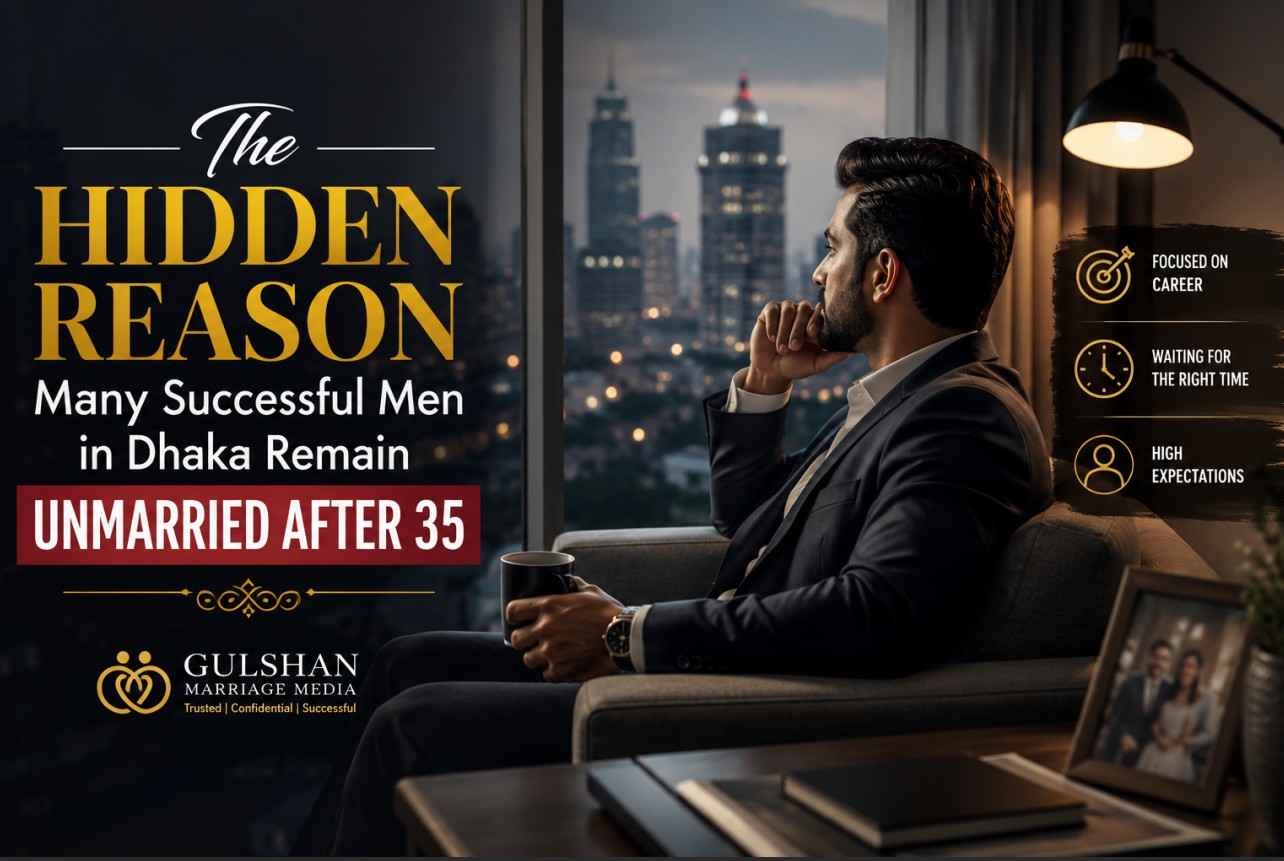
The Hidden Reason Many Successful Men in Dhaka Remain Unmarried After 35

Introduction: A Growing Trend Few People Talk About
Walk through the busy streets of Gulshan, Banani, Dhanmondi, Bashundhara, or Uttara, and you’ll find a growing number of men in their late thirties and even forties who appear to have everything society traditionally associates with success.
They own apartments.
They drive expensive cars.
They have stable careers.
Some run businesses worth millions of taka.
Others work for multinational companies, banks, government institutions, or international organizations.
Yet many of them remain unmarried.
This phenomenon has become increasingly visible in Dhaka over the last decade. Family gatherings often include whispers such as:
“He earns so much. Why isn’t he married?”
“Maybe he’s too picky.”
“Something must be wrong.”
“He’s waiting too long.”
While these assumptions are common, they rarely capture the full picture.
The reality is far more complicated than people imagine.
This article explores the hidden psychological, economic, cultural, and social reasons why many successful men in Dhaka remain unmarried after the age of 35—not to judge them, but to understand one of the most overlooked demographic shifts in modern Bangladesh.
Success Came First, Marriage Came Later
Previous generations followed a relatively predictable timeline.
- Find a job.
- Get married around 24–28.
- Have children.
- Build wealth afterward.
Today’s successful professionals often reverse this order.
Many spend their twenties focused almost entirely on:
- Higher education
- Professional certifications
- Foreign degrees
- Career development
- Entrepreneurship
- Financial independence
Marriage becomes something they postpone until “life is stable.”
The problem?
Stability keeps moving further away.
At 26 they think:
“I’ll marry after promotion.”
At 29:
“Maybe after buying a flat.”
At 32:
“Let me establish my business first.”
At 35:
“Now it’s becoming difficult.”
Without realizing it, years have passed.
Dhaka Has Become Extremely Expensive
Money affects marriage more than many people admit.
Dhaka is now one of South Asia’s most expensive cities relative to average income.
Even high-income professionals feel enormous financial pressure.
A successful man may already be responsible for:
- Supporting parents
- Paying siblings’ education
- Home loans
- Car loans
- Medical expenses
- Business investments
- Inflation
Marriage is no longer viewed as simply finding a partner.
Many perceive it as taking on another major financial responsibility.
Some even delay marriage because they fear they cannot maintain the lifestyle expected after marriage.
Ironically, even those earning very well sometimes feel financially unprepared.
The More Successful Someone Becomes, the Smaller Their Dating Pool
This is rarely discussed openly.
Success often reduces—not increases—the number of compatible partners.
Many highly successful men develop very specific lifestyles.
Examples include:
- Long working hours
- Frequent business travel
- High career ambitions
- Different social circles
- Financial discipline
- Personal routines
Finding someone compatible becomes harder.
Compatibility extends beyond beauty or education.
It includes:
- Values
- Lifestyle
- Communication
- Emotional maturity
- Career expectations
- Family expectations
- Religious compatibility
- Future goals
As standards become more refined, the number of genuinely compatible matches naturally decreases.
Family Expectations Have Changed
Bangladeshi families often want the “perfect” marriage.
Parents may expect a bride who is:
- Beautiful
- Highly educated
- Religious
- From a respectable family
- Financially stable
- Good at household responsibilities
- Career-oriented—but not too career-oriented
These expectations can become unrealistic.
Likewise, the bride’s family often has expectations regarding:
- Salary
- Property
- Social status
- Family reputation
- Future earning potential
Marriage slowly becomes less about two individuals and more about negotiations between two families.
This complexity causes delays.
Emotional Burnout Is More Common Than People Think
Many successful professionals spend years under intense pressure.
Daily stress includes:
- Deadlines
- Office politics
- Client management
- Business risks
- Financial uncertainty
- Competition
After ten or fifteen years of constant work, many become emotionally exhausted.
Instead of seeking marriage, they seek peace.
Some quietly admit:
“I don’t have the energy to start a relationship.”
Others fear emotional conflict more than loneliness.
Fear of Divorce Has Increased
Modern Dhaka has seen growing awareness of marital conflicts and divorce.
People personally know:
- Divorced friends
- Broken families
- Custody disputes
- Financial settlements
- Emotional trauma
Instead of viewing marriage as guaranteed happiness, many now see it as a major life risk.
This doesn’t mean they reject marriage.
It means they become extremely cautious.
Sometimes too cautious.
They Have Become Comfortable Living Alone
Humans adapt.
Someone who has lived independently for fifteen years develops routines.
Examples include:
- Choosing meals
- Managing finances
- Traveling alone
- Sleeping schedules
- Weekend hobbies
- Personal freedom
Marriage requires compromise.
After years of complete independence, compromise feels psychologically difficult.
It’s not selfishness.
It’s simply habit.
Career Success Often Replaces Social Life
Earlier generations met potential spouses through:
- Neighborhoods
- Universities
- Family gatherings
- Community events
Today’s professionals often spend:
- 10–12 hours working
- Evenings answering emails
- Weekends recovering
Their social circle shrinks.
Meeting new people becomes surprisingly difficult.
Ironically, someone with thousands of LinkedIn connections may know very few people personally.
Technology Has Changed Expectations
Social media creates unrealistic standards.
People constantly see:
- Luxury weddings
- Perfect couples
- Dream vacations
- Highly curated lifestyles
Comparison quietly influences expectations.
Some delay marriage waiting for someone who checks every imaginable box.
Others become overwhelmed by endless options.
Psychologists call this the “paradox of choice.”
More options sometimes produce less satisfaction.
The Hidden Fear of Losing Freedom
Many successful men privately value autonomy.
They control:
- Their schedule
- Their finances
- Their hobbies
- Their friendships
- Their travel plans
Marriage naturally changes all of these.
For someone accustomed to complete independence, this adjustment can feel intimidating.
This doesn’t necessarily mean they dislike commitment.
Rather, they worry about losing control over a life they worked hard to build.
Previous Relationship Experiences Leave Lasting Scars
Not every unmarried man has always been single.
Many experienced:
- Broken engagements
- Long-term relationships that ended
- Betrayal
- Family rejection
- Financial misunderstandings
Healing sometimes takes years.
Some never fully regain the willingness to start over.
Outwardly they appear successful.
Internally they remain emotionally cautious.
Society Often Misunderstands Single Men
Single women frequently face social pressure.
Single men experience it differently.
People assume:
- They’re arrogant.
- They’re commitment-phobic.
- They must have unrealistic standards.
- Something must be wrong.
These assumptions ignore the diversity of individual experiences.
Remaining unmarried does not automatically indicate unhappiness or personal failure.
Marriage Markets Have Become More Competitive
Marriage in urban Bangladesh increasingly resembles a complex matching process.
Education, income, family background, religion, career goals, and personal preferences all play larger roles than before.
Highly educated women often seek partners with equal or greater educational and professional achievements.
Highly successful men often seek emotional compatibility alongside shared values.
As expectations rise on both sides, matching becomes slower.
This is not necessarily because either group is “too demanding,” but because the number of overlapping preferences becomes smaller.
Work-Life Balance Is Harder Than Ever
Dhaka’s traffic alone consumes hours every week.
Combine that with demanding careers, networking, family responsibilities, and digital connectivity, and many professionals struggle to maintain a healthy personal life.
Relationships require time.
Time has become one of the rarest resources.
Some men postpone marriage simply because they believe they cannot currently give a spouse the attention they deserve.
Mental Health Is Finally Entering the Conversation
Although discussions around mental health remain limited in Bangladesh, awareness is improving.
Anxiety, chronic stress, burnout, perfectionism, and depression can all influence relationship decisions.
Someone who appears highly successful externally may privately be dealing with emotional challenges they have never discussed with anyone.
Choosing to delay marriage may, in some cases, reflect a desire to become emotionally healthier before committing to another person.
The Search for Emotional Compatibility
Many people once prioritized practical considerations above all else.
Today, emotional connection matters more than ever.
Successful professionals often want a partner who can be:
- A trusted friend
- An intellectual companion
- Emotionally supportive
- Financially responsible
- Respectful of boundaries
- Independent yet collaborative
Finding this combination is naturally difficult.
As a result, some choose to wait rather than enter a marriage they believe will be incompatible.
Religious and Personal Values Matter
Bangladesh is culturally and religiously diverse in how individuals practice their values.
For many successful men, compatibility is not only about education or appearance but also about shared beliefs, ethics, family roles, and long-term life goals.
Differences in expectations about parenting, finances, or religious practice can become significant sources of conflict after marriage.
Some therefore spend more time searching for genuine alignment instead of making a quick decision.
Family Responsibilities Can Delay Marriage
In many Bangladeshi families, the eldest son carries significant responsibilities.
He may contribute to:
- Parents’ medical care
- Younger siblings’ education
- Household expenses
- Family businesses
By the time these responsibilities lessen, he may already be in his mid- or late-thirties.
Marriage was never rejected—it was simply delayed.
Perfection Can Become the Enemy of Commitment
Success often develops habits that are useful at work:
- Careful planning
- Risk analysis
- Attention to detail
- High standards
These qualities can become obstacles in personal relationships.
Unlike business decisions, relationships rarely provide complete certainty.
Waiting for the “perfect” moment or the “perfect” partner may result in waiting indefinitely.
Learning to accept that no relationship is flawless is often an important step toward commitment.
Is Remaining Unmarried After 35 a Problem?
Not necessarily.
Marriage is a deeply personal decision.
Some individuals lead meaningful, fulfilling lives while remaining single.
Others genuinely wish to marry but have not found the right circumstances or partner.
The key issue is intentionality.
If someone consciously chooses to remain unmarried and is content with that choice, there is nothing inherently wrong with it.
If someone feels trapped by fear, unrealistic expectations, or circumstances beyond their control, understanding those factors can help them make more informed decisions.

What Can Families Do?
Families can play a constructive role by:
- Respecting their adult children’s autonomy.
- Encouraging open conversations instead of constant pressure.
- Focusing on compatibility rather than superficial status.
- Avoiding unrealistic checklists for potential spouses.
- Recognizing that marriage is only one measure of a successful life.
Supportive families often create healthier environments for thoughtful decision-making than families that rely on constant comparison or criticism.
What Can Individuals Do?
For unmarried professionals who hope to marry, a few practical approaches may help:
- Reflect on priorities.Distinguish between essential values and preferences that may be negotiable.
- Invest in relationships, not only careers.Meaningful connections require time and effort.
- Communicate honestly.Discuss expectations about finances, family, careers, and future goals early.
- Accept uncertainty.No marriage comes with guarantees.
- Seek support if needed.Trusted friends, mentors, or counselors can provide perspective during major life decisions.
The Future of Marriage in Dhaka: A New Definition of Success
As Dhaka continues to transform into a fast-paced metropolitan city, the traditional definition of adulthood is evolving alongside it. For decades, society viewed success as a simple sequence: complete education, secure a stable job, get married, buy a house, and raise a family. Today, that sequence is no longer universal.
Many young professionals now prioritize personal development, financial security, international education, entrepreneurship, and career advancement before considering marriage. This shift is not unique to Bangladesh. Similar trends can be observed in cities like Singapore, Seoul, Tokyo, London, and New York, where people are marrying later than previous generations.
Dhaka is gradually following this global pattern.
However, unlike many Western societies, Bangladesh still places significant cultural importance on marriage. Remaining unmarried after 35 often attracts questions from relatives, neighbors, colleagues, and even strangers. Social gatherings frequently include inquiries such as, “When are you getting married?” or “Why are you waiting so long?” While these questions may come from genuine concern, they can also create unnecessary pressure and reinforce the misconception that personal worth is tied to marital status.
The reality is that modern success involves far more than income or relationship status. Emotional intelligence, mental well-being, meaningful friendships, financial stability, physical health, and personal fulfillment are increasingly recognized as equally important aspects of a successful life.
The Role of Communication in Modern Relationships
Another hidden reason many successful men remain unmarried is the changing nature of communication. In the past, arranged marriages often progressed through family introductions, and couples gradually built their relationship after marriage. Today, expectations have shifted.
Potential partners are expected to communicate openly about topics such as career goals, financial planning, lifestyle preferences, family responsibilities, religion, parenting styles, and personal boundaries before making a lifelong commitment.
While this greater transparency is positive, it also makes the process more complex. A single disagreement on a major life issue can end a promising match before it progresses further. Successful professionals, accustomed to making calculated decisions, may spend months—or even years—evaluating compatibility.
This careful approach is not necessarily a sign of indecision. Rather, it reflects a growing understanding that a successful marriage requires more than shared backgrounds; it requires ongoing communication and mutual respect.
The Importance of Emotional Readiness
Financial readiness and emotional readiness are often confused, yet they are entirely different concepts.
A man may own multiple properties, lead a successful company, or hold a prestigious executive position, but still feel emotionally unprepared for marriage. Emotional readiness involves patience, empathy, conflict resolution, vulnerability, and the willingness to prioritize another person’s needs alongside one’s own.
Many successful professionals openly admit that building a business or climbing the corporate ladder was easier than learning to maintain healthy relationships.
This realization often comes later in life, after years of focusing primarily on career achievements. Some use this period to develop greater self-awareness, improve emotional intelligence, and understand what they genuinely seek in a life partner rather than simply responding to social expectations.
Redefining Success Beyond Marriage
Perhaps the most important lesson emerging from this trend is that success should never be measured by a single milestone.
Marriage can be a deeply rewarding experience, but it is not the only path to a meaningful life. Likewise, remaining single does not automatically indicate loneliness, failure, or incompleteness.
A person’s contribution to society, professional accomplishments, kindness, integrity, family support, community involvement, and personal growth all reflect different forms of success.
As Bangladesh becomes increasingly urbanized and globally connected, public attitudes toward marriage may gradually become more flexible. Instead of assuming that everyone should follow the same timeline, society can recognize that each individual faces unique circumstances, aspirations, and responsibilities.
Ultimately, the hidden reason many successful men in Dhaka remain unmarried after 35 is not a single factor but the intersection of economic realities, evolving cultural expectations, emotional maturity, personal choice, and the pursuit of genuine compatibility. Behind every unmarried individual is a unique story that cannot be understood through stereotypes or assumptions.
Rather than asking why someone has not yet married, perhaps a more meaningful question is whether they are living a life that reflects their values and aspirations. After all, the true measure of success is not how quickly someone reaches life’s traditional milestones, but how thoughtfully they make the decisions that shape their future.
Conclusion
The image of the successful yet unmarried man in Dhaka is often misunderstood.
From the outside, people see financial success, professional achievement, and independence. What they rarely see are the invisible factors beneath the surface: years devoted to career-building, rising living costs, family obligations, emotional burnout, fear of making the wrong choice, changing expectations, and the challenge of finding genuine compatibility in a fast-changing society.
The reasons are rarely simple, and they are rarely the same for everyone.
Some men remain unmarried because they prioritized education and career. Others delayed marriage while supporting their families. Some became cautious after painful experiences. Others simply have not yet met someone whose values, goals, and personality align with their own.
At the same time, it is important to avoid turning this into a stereotype. Many successful men marry before 35, and many unmarried men are not financially successful. Likewise, women in Dhaka increasingly face similar challenges as they pursue higher education, careers, and personal independence. The broader trend reflects changing social and economic realities rather than a flaw in any one group.
Ultimately, marriage should not be viewed as a race against age or a social status symbol. A healthy marriage depends far more on mutual respect, emotional maturity, shared values, and willingness to grow together than on meeting a particular deadline. Whether someone marries at 28, 38, or chooses not to marry at all, the quality of their relationships—and the authenticity of their choices—matters more than society’s expectations.
As Dhaka continues to modernize, conversations about marriage also need to evolve. Instead of asking, “Why is he still unmarried?” perhaps a better question is, “What realities are shaping people’s decisions today?” Understanding those realities with empathy, rather than judgment, may lead to healthier relationships and a more compassionate society for everyone.