




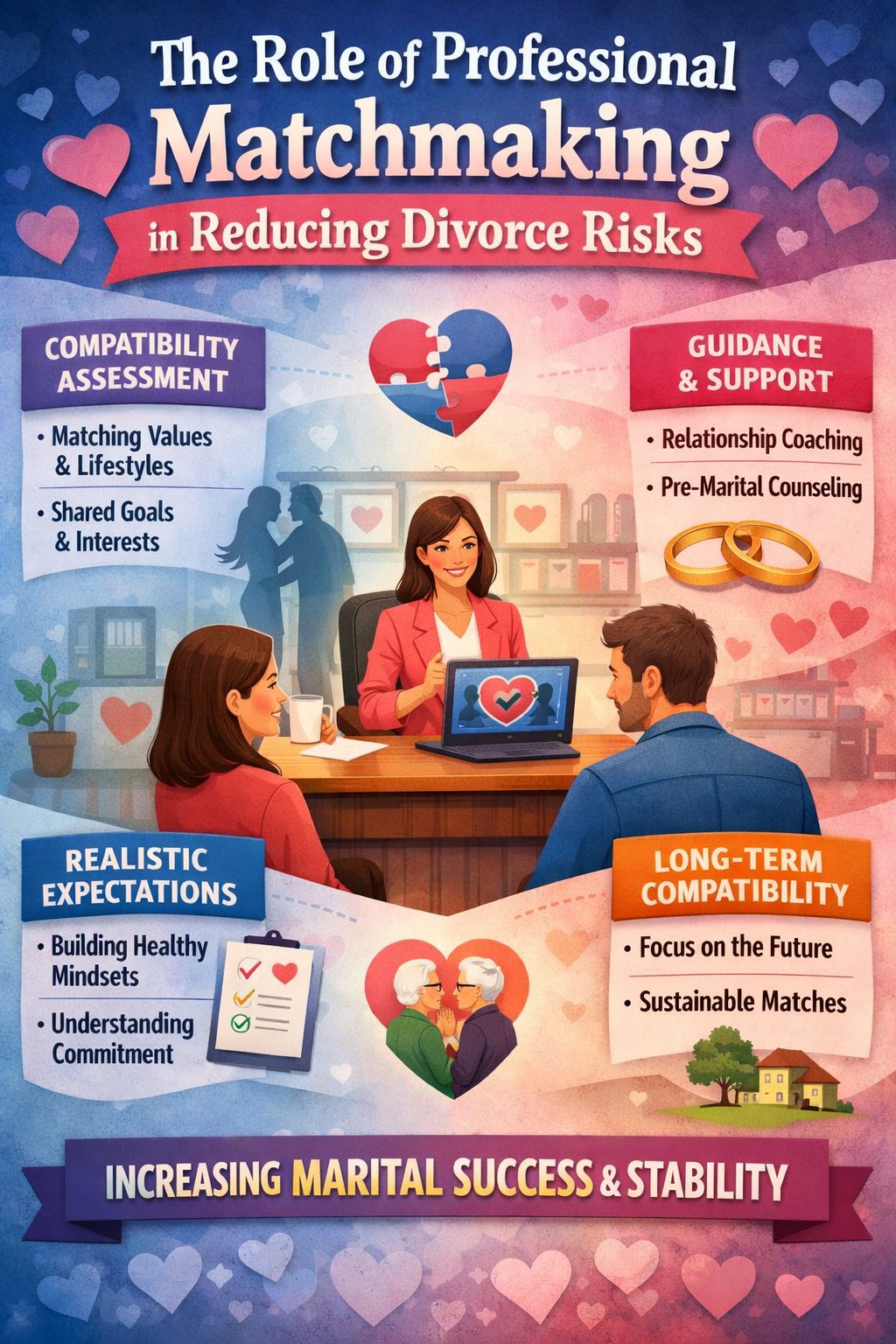
The Role of Professional Matchmaking in Reducing Divorce Risks
Introduction
Marriage is one of the most significant decisions a person makes in life. It’s not simply the union of two individuals — it’s the joining of families, values, expectations, and futures. Globally, divorce rates have risen dramatically over the past few decades, driven by evolving lifestyles, social pressures, unrealistic expectations, and lack of compatibility. In Bangladesh too, especially among the urban and elite classes, couples are increasingly facing post-marriage conflicts leading to separation.
In this context, professional matchmaking has emerged as a promising solution — not only to help people find partners but also to reduce the risk of divorce by building marriages on a foundation of deep compatibility, shared goals, and emotional preparedness. This article explores how professional matchmaking services — like Gulshan Marriage Media — play a strategic role in reducing divorce risks in modern society.
- Understanding Divorce: The Core Causes
Before we explore how professional matchmaking reduces divorce risks, it’s important to understand why divorces happen in the first place.
1.1 Lack of Compatibility
In many marriages — especially arranged ones — initial decisions are based on surface-level factors such as education, income, family reputation, and social status. While these are valuable criteria, they don’t necessarily translate into emotional or psychological compatibility. Couples may discover later that they don’t share key attitudes towards finances, parenting, life goals, or personal boundaries.
1.2 Unrealistic Expectations
Many people enter marriage with idealized notions of what a spouse should be like. Social media and cultural narratives often paint marriage as a guarantee of happiness, leading individuals to expect perfection from their partners. When reality fails to match expectation, disappointment can turn into conflict.
1.3 Poor Communication Skills
Communication problems are among the top predictors of marital failure. Difficulty in expressing needs, resolving disagreements, and listening empathetically can lead to a breakdown of trust and emotional connection.
1.4 Family Interference
In South Asian cultures — including Bangladesh — extended family opinions matter a lot. Sometimes, the involvement of relatives before and after marriage influences relationship dynamics negatively, especially if families have conflicting values.
1.5 Financial Stress
Money is a major stressor in married life. Differences in financial values — such as saving vs. spending, shared vs. separate finances, lifestyle choices — often escalate into serious conflict if not addressed early.
- Traditional Matchmaking vs. Professional Matchmaking
2.1 Traditional Matchmaking
Traditionally, families and close community networks facilitate matches based on:
- Caste or community
- Family reputation
- Educational background
- ‘Good’ income
This approach has limitations:
- Limited exposure to potential matches
- Family biases may override personal preferences
- Lack of systematic profiling or background verification
- No structured compatibility assessment
This means couples may meet too late in the process or discover incompatibilities only after the wedding.
2.2 What Professional Matchmaking Is
Professional matchmaking is a systematic, personalized, and strategic approach in helping individuals find compatible partners. It goes far beyond browsing profiles online. It involves:
- Detailed personality and psychometric assessments
- Deep interviews to understand values, goals, and beliefs
- Cultural and family-context evaluation
- Compatibility analysis using proven methodologies
- Confidential background verification
- Ongoing guidance and counseling
The goal isn’t just finding someone — it’s helping individuals find the right someone.
- How Professional Matchmaking Reduces Divorce Risk
Now let’s explore how this structured approach significantly lowers the chance of divorce compared to casual or traditional match selection.
3.1 Deeper Compatibility Assessment
Professional matchmakers use sophisticated tools to assess:
- Personality types
- Conflict response styles
- Emotional needs
- Long-term life goals
Instead of only matching based on basic profile data like age or education, they match on core psychological compatibility, which predicts long-term success more accurately than superficial factors.
When couples align on:
- Communication styles
- Life goals (children, career, location)
- Emotional needs and boundaries
— they are more likely to thrive long-term.
This is key because research shows that compatibility in values and life goals is one of the strongest predictors of marital satisfaction.
3.2 Educating Clients on Realistic Expectations
Many couples enter marriage with unrealistic views of love and partnership, shaped by media illusions. Professional matchmakers:
- Prepare clients emotionally
- Help them understand real marriage dynamics
- Discuss potential challenges
- Teach expectations that are achievable and healthy
This early expectation management reduces disillusionment, a major cause of conflict.
3.3 Facilitating Communication and Conflict Awareness
Matchmakers often:
- Facilitate initial guided conversations
- Help couples understand how they communicate
- Identify potential areas of conflict early
Couples learn how their partner reacts under stress, approaches arguments, and expresses emotions — long before they are committed. Awareness like this increases empathy and reduces future misunderstandings.
3.4 Counseling and Family Guidance
Many services offer pre-marital counseling:
- Discuss expectations between partners
- Address family interference issues
- Help families understand boundaries
This reduces one of the strongest predictors of marital stress in South Asian marriages — conflict between families.
3.5 Background Verification and Transparency
Professional matchmakers conduct:
- Background checks
- Verification of credentials
- Family reputation assessment
Transparency promotes trust — one of the foundations of a successful marriage. When both partners enter with full confidence in the other’s integrity, the risk of future conflict decreases.
3.6 Personalized Matching — Not Mass Algorithm Matching
Unlike many online platforms that show profiles algorithmically based on filters, professional matchmaking:
- Involves human judgment
- Deeply evaluates emotional and personality traits
- Matches based on holistic compatibility
This personalized process filters out mismatches that machines or casual browsing cannot detect.
- Common Areas Where Matchmaking Prevents Future Problems
Let’s examine specific areas where matchmaking reduces divorce triggers:
4.1 Financial Compatibility
Couples are assessed on:
- Spending vs. saving habits
- Long-term financial goals
- Career planning and relocation preferences
Aligning financial expectations early prevents future conflict.
4.2 Cultural and Traditional Expectations
Matchmakers check:
- Religious practices
- Social lifestyle expectations
- Extended family roles
- Traditions and rituals preferences
This reduces clash of values.
4.3 Parenting and Family Goals
Do both partners want children?
If yes:
- When?
- How many?
Their answers must align or be negotiated under supervision.
Unaddressed differences in parenting goals can become major divorce triggers later.
4.4 Emotional and Psychological Profiles
Matchmakers often use psychometric tools to understand:
- Attachment styles
- Conflict resolution strategies
- Communication tendencies
- Emotional needs
Understanding emotional makeup — before marriage — creates empathy and reduces future misunderstandings.
- Case Studies: Professional Matchmaking Success
Here are anonymized illustrative examples:
Case 1: Misaligned Life Goals Prevented a Faulty Match
Two professionals seemed perfect on paper:
- Similar education
- Similar income
- Same religious background
But the matchmaking assessment revealed:
- One partner prioritized global career mobility
- The other prioritized family settlement in Dhaka
Identifying this before marriage saved both from future conflict and divorce.
Case 2: Emotional Compatibility Identified Early
A couple communicated well verbally but had opposite emotional needs:
- One needed frequent emotional reassurance
- The other preferred personal space
Because the matchmaker identified these differences early, both received guidance and tools to meet each other’s needs — resulting in a stable and harmonious marriage.
- Why Marriage Counseling Alone Is Not Enough
Many couples seek counseling after problems arise — sometimes too late. Counseling helps, but:
- It treats symptoms, not root causes
- Often comes after conflict has escalated
- Emotional damage may already be done
Professional matchmaking prevents mismatch root causes from occurring in the first place.
In other words, it’s preventative — not reactive.
- Professional Matchmaking — A Growing Trend in Urban Bangladesh
With globalization, education, and career focus rising in cities like Dhaka, Chattogram, and Sylhet, young professionals are:
- Delaying marriage
- Facing difficulty finding compatible partners
- Preferring deeper assessments over superficial matches
Professional matchmaking fills this gap — and increasingly, divorce-averse families are turning to it.
- Common Misconceptions About Professional Matchmaking
Myth 1: It’s Only for Wealthy People
Reality: Everyone with serious intent — regardless of income — benefits from structured compatibility assessment.
Myth 2: It’s Like Online Matrimony Sites
Reality: It’s personalized, confidential, and guided by human experts — not automated algorithms.
Myth 3: It Takes Too Long
Reality: A deliberate process leads to fewer failed marriages and lower emotional cost in the long run.
Myth 4: Futuristic Compatibility Tools Are Unnecessary
Reality: These tools reduce guesswork, prevent risk, and select partners who can grow together.
- How to Choose a Trustworthy Matchmaking Service
If reducing divorce risk is your priority, select services that offer:
✔ Deep personality profiling
✔ Compatibility analysis beyond basic biodata
✔ Family assessments
✔ Pre-marital counseling
✔ Confidential screening
✔ Expert guidance at every step
Not all services are equal — so choose one with a proven methodology, ethical practices, client testimonials, and emotional support systems.
- Conclusion: Marriage Is Not a Chance — It’s a Choice
Marriage should not be left to chance, hope, or superficial filters. It’s a lifelong commitment that requires:
- Emotional intelligence
- Communication alignment
- Compatibility in values
- Shared vision for life
Professional matchmaking does not guarantee a fairy-tale ending — no service can — but it dramatically increases the likelihood of long-term success by preventing predictable conflict triggers.
By helping couples:
- Understand themselves deeply
- Learn about each other before commitment
- Align expectations realistically
- Build trust and mutual respect
— professional matchmaking reduces divorce risks and strengthens the foundation of lifelong partnership.
The Role of Professional Matchmaking in Reducing Divorce Risks
(Extended Analysis: Social Trends, Psychological Depth, Long-Term Stability & Strategic Prevention)
11. The Hidden Psychological Patterns That Lead to Divorce
Many divorces do not happen because of one dramatic event. They happen due to slow emotional erosion. Professional matchmaking reduces divorce risk because it addresses psychological blind spots most individuals are unaware of.
11.1 Attachment Styles and Long-Term Conflict
Psychologists often categorize attachment into:
- Secure
- Anxious
- Avoidant
- Fearful-avoidant
When an anxious individual marries an avoidant one without awareness, the dynamic can become destructive:
- One demands reassurance.
- The other withdraws.
- Conflict escalates.
Professional matchmakers who understand personality psychology can detect these patterns early. Instead of blindly pairing two high-achieving professionals, they assess whether their emotional wiring complements or clashes.
Preventing attachment mismatches prevents emotional burnout — one of the silent precursors to divorce.
12. Social Media and the Illusion of Better Options
Modern divorce risk is fueled by comparison culture.
Social media creates:
- Unrealistic marriage standards
- Constant comparison with other couples
- Emotional dissatisfaction
- Temptation of “better options”
Professional matchmaking counters this by:
- Emphasizing intentional selection
- Encouraging commitment-focused mindset
- Reinforcing realistic expectations
When individuals understand they chose a partner based on structured compatibility — not impulse — their commitment becomes stronger. Doubt reduces. Emotional stability increases.
13. The Economics of Divorce vs. The Investment in Matchmaking
Divorce is expensive — emotionally and financially.
Financial Costs:
- Legal fees
- Asset division
- Relocation expenses
- Child custody battles
Emotional Costs:
- Depression
- Family strain
- Social stigma
- Reduced productivity
Professional matchmaking may appear costly initially, but it is a preventive investment. It reduces:
- Wrong matches
- Emotional trauma
- Long-term financial damage
Viewed strategically, matchmaking is not a luxury — it’s risk management.
14. High-Achievers Face Unique Divorce Risks
Doctors, CEOs, entrepreneurs, and senior professionals face specific challenges:
- Time constraints
- High stress
- Strong personalities
- Lifestyle imbalance
- Decision-making dominance issues
Traditional matchmaking often ignores these realities. Professional matchmaking addresses:
✔ Lifestyle compatibility
✔ Work-life expectation alignment
✔ Ego balance
✔ Leadership personality compatibility
Two leaders in a marriage must negotiate power respectfully. If both demand control without compromise, conflict becomes inevitable.
Matchmakers trained in personality dynamics can detect power imbalance risks early — before commitment.
15. The Role of Confidentiality in Reducing Divorce Risk
Public matchmaking platforms expose individuals to:
- Casual inquiries
- Reputation risks
- Emotional misuse
- Inconsistent communication
Confidential professional matchmaking:
- Screens serious candidates
- Protects family dignity
- Maintains discretion
- Filters unserious proposals
When a match begins in a respectful and structured environment, it sets a tone of maturity. That maturity carries forward into marriage.
16. Cultural Alignment and Value Systems
Many divorces stem from cultural mismatch, especially in:
- Religious practices
- Gender roles
- Family boundaries
- Social lifestyle expectations
Professional matchmakers conduct deep conversations about:
- Festival practices
- Religious observance intensity
- Financial responsibility sharing
- Living arrangements (joint vs nuclear family)
- Social exposure comfort level
These discussions may feel uncomfortable early — but avoiding them increases divorce risk later.
Pre-marital clarity prevents post-marital resentment.
17. Emotional Intelligence as a Divorce Shield
Emotional intelligence (EQ) is often more important than IQ in marriage.
High IQ couples without EQ struggle with:
- Ego clashes
- Poor listening
- Defensive arguments
- Lack of empathy
Professional matchmaking services increasingly assess emotional maturity by observing:
- Reaction to rejection
- Communication tone
- Conflict handling in early conversations
- Respectful negotiation behavior
Emotionally immature individuals may appear perfect on paper but struggle in real marriage dynamics.
Screening for EQ significantly reduces divorce probability.
18. Pre-Marital Counseling as Preventive Medicine
Marriage counseling is often reactive. Pre-marital counseling is preventive.
Professional matchmaking integrates:
- Communication workshops
- Expectation alignment sessions
- Conflict simulation discussions
- Financial planning conversations
Couples who discuss difficult topics before marriage are less shocked after marriage.
Topics often covered:
- In-law boundaries
- Financial independence
- Career sacrifices
- Children planning
- Intimacy expectations
- Social freedom
Structured conversation builds resilience.
19. Reducing Ego-Based Marriages
Many marriages fail because they were based on:
- Status
- Wealth display
- Family competition
- Social pressure
Professional matchmaking helps individuals shift from:
“Who looks impressive?”
to
“Who is compatible long-term?”
This shift in mindset alone dramatically reduces divorce risk.
Ego marriages are fragile. Compatibility marriages are durable.
20. The Silent Role of Family Dynamics
In South Asian contexts, family is not optional — it’s central.
Divorce risk increases when:
- Families compete
- Boundaries are unclear
- Respect expectations are mismatched
- Financial contributions are disputed
Professional matchmakers:
- Assess family temperament
- Identify dominant family members
- Clarify expectations before engagement
When families align respectfully, the couple gains a support system instead of a battlefield.
21. Second Marriage and Higher Divorce Risk
Second marriages statistically face higher divorce rates globally due to:
- Emotional baggage
- Trust issues
- Children from previous marriage
- Financial complications
Professional matchmaking is especially critical here because it:
- Screens for emotional readiness
- Clarifies expectations with step-parenting
- Assesses healing from past trauma
- Ensures transparent discussion
Careful matching reduces repeated mistakes.
22. The Role of Patience in Professional Matchmaking
Quick matches often lead to quick regrets.
Professional matchmaking emphasizes:
- Slow evaluation
- Multiple structured conversations
- Observation of behavior consistency
- Family meeting dynamics
Time reveals character.
Rushed marriages ignore red flags.
Patience reduces divorce risk by allowing informed commitment.
23. Why “Love Alone” Is Not Enough
Romantic love is powerful — but unstable when unsupported by:
- Shared values
- Financial compatibility
- Family harmony
- Emotional regulation
- Mutual respect
Professional matchmaking does not eliminate love — it strengthens it by building rational compatibility underneath emotional attraction.
When logic supports emotion, marriage becomes stable.
24. Red Flags Professional Matchmakers Detect Early
Experienced matchmakers identify warning signs like:
🚩 Extreme controlling behavior
🚩 Financial secrecy
🚩 Disrespectful communication
🚩 Inconsistent life goals
🚩 Avoidance of serious discussions
🚩 Family hostility
These may not appear in biodata — but surface in structured conversations.
Early detection prevents emotional disasters.
25. Long-Term Growth Compatibility
Marriage is not static.
Professional matchmaking evaluates:
- Growth ambition
- Adaptability
- Openness to change
- Conflict repair ability
- Long-term life vision
Two people may be compatible today — but incompatible in growth direction.
Aligning future vision is crucial to reducing long-term divorce risk.
26. Professional Matchmaking as Emotional Coaching
Beyond pairing individuals, matchmakers often:
- Guide nervous clients
- Manage unrealistic expectations
- Encourage compromise
- Discourage ego-driven rejection
This emotional coaching shapes healthier marital mindset.
A prepared individual makes a better spouse.
27. Data vs. Intuition: The Balanced Approach
Online apps rely purely on data filters.
Traditional families rely purely on intuition.
Professional matchmaking combines:
✔ Structured data
✔ Psychological assessment
✔ Cultural awareness
✔ Human intuition
✔ Experience-based judgment
This balanced model reduces blind spots.
28. Preventing Silent Marriages
Some marriages don’t divorce — they emotionally disconnect.
Emotional disconnection leads to:
- Loneliness
- Affair risk
- Psychological distress
Professional matchmaking reduces this by prioritizing:
- Communication compatibility
- Shared hobbies
- Intellectual alignment
- Emotional depth
The goal is not just “married” — but “connected.”
29. Why Divorce Prevention Requires Professional Structure
Marriage success cannot depend on luck.
It requires:
- Intentional evaluation
- Structured dialogue
- Emotional readiness
- Value alignment
- Future vision compatibility
Professional matchmaking creates this structure.
30. Final Perspective: Marriage as Strategic Life Architecture
Marriage shapes:
- Emotional stability
- Financial future
- Children’s psychology
- Social reputation
- Mental health
Choosing a spouse casually risks all of these pillars.
Professional matchmaking is not about elitism.
It is about responsibility.
It transforms marriage from:
A hopeful gamble
into
A carefully designed life partnership.
Closing Thought
Divorce is rarely sudden.
It grows from:
- Mismatch
- Miscommunication
- Misaligned expectations
- Emotional neglect
Professional matchmaking reduces these risks by intervening at the beginning — where decisions matter most.
Marriage should not be rushed, random, or reputation-driven.
It should be:
Deliberate.
Compatible.
Emotionally intelligent.
Future-focused.
When the foundation is built carefully, the structure stands strong.

Call to Action
If you’re serious about finding a compatible life partner — not just a profile — consider professional matchmaking. It’s not about perfection. It’s about matching wisely.
👉 Gulshan Marriage Media specializes in confidential, psychology-based matchmaking designed for modern lives.
Whether you want guidance, compatibility assessment, or expert support in your marriage journey — our team is here to help.