






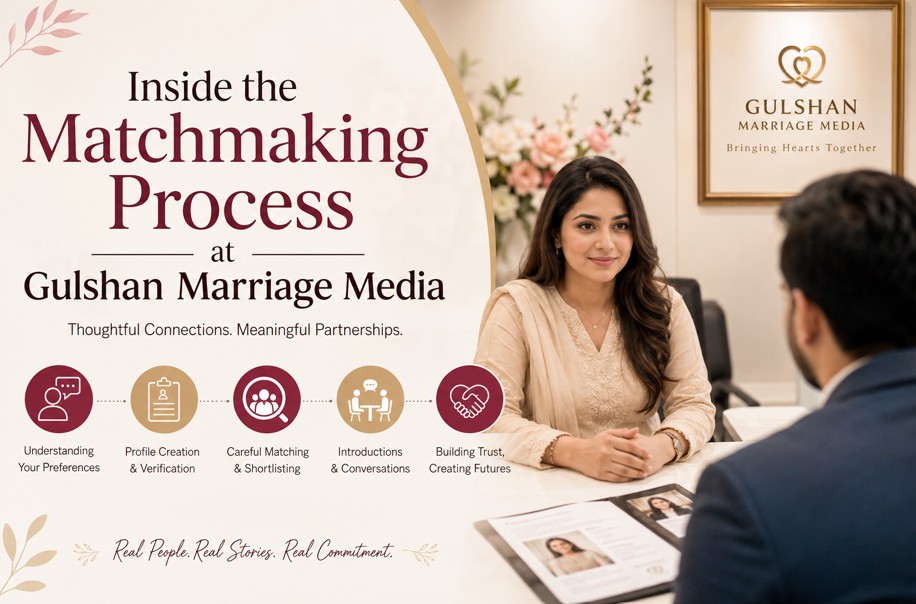
Inside the Matchmaking Process at Gulshan Marriage Media: From Profiles to Promising Partnerships
In a world where people can connect with hundreds of strangers through a few taps on a screen, finding one genuinely compatible life partner can still feel surprisingly difficult. Marriage is not simply about discovering a person with an impressive biodata, a good job, or a pleasant photograph. It is about building a future with someone whose values, priorities, lifestyle, family expectations, and emotional maturity can align with your own.
That is where professional matchmaking becomes different from casual online searching. At Gulshan Marriage Media, the purpose of matchmaking is not to rush two people into a decision. It is to create thoughtful, respectful, and meaningful introductions that give individuals and families the clarity to explore a serious relationship with confidence.
Many people see only the final result: two families meeting, an engagement announcement, or a wedding celebration. But the path that leads to a successful match involves much more. It includes listening, profile understanding, compatibility analysis, careful shortlisting, privacy protection, family coordination, honest feedback, and patience. Every successful marriage story begins long before the first formal meeting.
This article takes you inside the matchmaking process at Gulshan Marriage Media and explains how a structured, people-first approach helps turn individual profiles into promising partnerships.
Why Matchmaking Still Matters in a Digital Age
Technology has made introductions easier, but it has not necessarily made decision-making easier. A large number of options can create confusion. Many people spend months speaking with unsuitable matches because the initial conversation began without clear priorities. Others face discomfort because personal details are shared too freely, expectations are not discussed early, or families become involved only after emotional energy has already been invested.
A professional marriage media service adds direction to this process. Instead of treating marriage as a quick transaction or a numbers game, the focus is placed on quality, relevance, discretion, and long-term compatibility.
At Gulshan Marriage Media, matchmaking begins with a simple but important understanding: every person is more than a profile. A biodata may show education, occupation, age, height, family background, and location. These details matter, of course. But they do not show how someone handles responsibility, what kind of home environment they hope to create, how they think about career and family, or what they expect from a life partner.
A meaningful match is often found in the space between the visible and the personal. That is why the process needs both structure and human judgment.
Step One: Understanding the Person Behind the Profile
The matchmaking journey begins with a detailed registration and consultation process. This is not merely a formality. It is the foundation of everything that follows.
A member’s profile typically includes basic details such as age, education, profession, marital status, religion, location, family background, and lifestyle preferences. However, a responsible matchmaking process goes deeper. The conversation also explores the person’s priorities, values, hopes, and non-negotiables.
For example, one member may place a strong emphasis on educational compatibility. Another may care more about shared family values, emotional warmth, religious practice, career flexibility, or living arrangements after marriage. Some prefer a partner from a similar professional background, while others are open to different careers but want maturity, communication skills, and mutual respect.
This early stage is about asking the right questions. What kind of partnership does the person imagine? Are they looking for someone who wants to build a career, start a family soon, live in a joint family, or establish an independent household? How important is geographical location? Is relocation possible? What kind of personality would make them feel understood and comfortable?
There are no “correct” answers. Every individual has different needs. The goal is not to judge preferences but to understand them clearly enough to make better introductions.
At Gulshan Marriage Media, this stage helps reduce unnecessary mismatches later. When a person’s expectations are discussed openly at the beginning, the shortlist becomes more relevant, conversations become more honest, and the overall experience becomes less stressful.
Step Two: Creating a Complete and Respectful Biodata
A biodata is often the first formal introduction between two potential partners. It should be informative without becoming overly personal. A well-prepared biodata creates a balanced picture of the individual and helps both sides decide whether an initial conversation makes sense.
The profile may include personal details, educational qualifications, professional information, family background, interests, and a brief description of the kind of partner the person is seeking. It may also include photographs that are appropriate, recent, and shared according to the member’s comfort level.
The way a profile is written matters. A good biodata should communicate dignity, honesty, and clarity. It should not exaggerate achievements or hide major information that would become important later. Marriage is a long-term commitment, so a transparent beginning is always healthier than an impressive but incomplete presentation.
At Gulshan Marriage Media, profiles are treated as serious documents, not casual advertisements. The aim is to present members respectfully and accurately. A thoughtfully written profile makes it easier for potential matches to understand the person’s background and allows matchmaking consultants to identify meaningful points of compatibility.
This stage also gives members the chance to reflect on themselves. Writing down personal priorities can reveal what truly matters. Sometimes people begin with a long list of preferences but later realize that character, respect, communication, and shared direction matter more than small surface-level details. This self-awareness is valuable because it improves the quality of every future introduction.
Step Three: Screening and Profile Verification
Trust is one of the most important parts of matchmaking. Before families invest time, emotions, and hope, they want to feel that the information being shared is reliable. This is why a careful screening approach is essential.
The exact verification process may vary depending on the member, the information available, and the service arrangement. However, the purpose remains the same: to encourage honest profiles and reduce avoidable uncertainty. Information related to education, occupation, family background, marital status, and other important details should be communicated responsibly.
Screening does not mean invading a person’s privacy. It means creating a safer environment where members understand that honesty is expected. A professional service must balance discretion with transparency. Sensitive personal information should not be circulated casually, but major facts that affect marriage decisions should not be hidden either.
At Gulshan Marriage Media, trust is built through clear communication. Members are encouraged to be straightforward about their circumstances, preferences, and expectations. Whether someone is a first-time bride or groom, divorced, widowed, a single parent, living abroad, or working in a demanding profession, their journey deserves respect. A mature matchmaking process understands that every life story is different.
This respectful approach is especially important because marriage decisions are emotional. People should never feel pressured to share more than necessary in the early stage. At the same time, both sides deserve enough clarity to decide whether they want to continue. The right balance protects dignity and supports informed choices.
Step Four: Looking Beyond Basic Matching Criteria
A simple matching system can compare age, education, profession, location, religion, or marital status. Those factors are useful, but they are only the starting point. The real work of matchmaking begins when the process looks beyond these categories.
Compatibility has many layers. Two people may have similar educational backgrounds but very different expectations about career after marriage. They may belong to respected families but have opposite communication styles. They may live in the same city but want completely different lifestyles.
Gulshan Marriage Media considers several broader areas when building a shortlist:
Values and Priorities
What does each person consider essential in a marriage? Do they value family involvement, independence, religious practice, financial planning, simplicity, ambition, or social life in similar ways?
Lifestyle Expectations
How do they imagine daily life after marriage? Do they prefer a busy urban routine, a quieter home-centered life, travel, social gatherings, or a more private lifestyle?
Family Culture
Are both sides comfortable with similar levels of family involvement? Do they understand each other’s traditions, expectations, and boundaries?
Communication and Temperament
A calm and reserved person may be compatible with someone expressive, but only when both respect each other’s styles. Personality is not about finding identical people. It is about finding people who can communicate, compromise, and grow together.
Future Plans
Career development, higher studies, relocation, children, business ambitions, and care for parents can all shape married life. These topics are best explored early and respectfully.
By taking these factors seriously, the matchmaking process becomes more thoughtful. A match is not chosen simply because two profiles “look good on paper.” It is considered because there is a reasonable possibility of shared direction.
Step Five: Curating a Meaningful Shortlist
Once a member’s preferences and profile have been understood, the next stage is shortlisting. This is where professional judgment becomes particularly valuable.
Instead of overwhelming members with a long list of random profiles, Gulshan Marriage Media focuses on presenting potential matches that have a genuine basis for consideration. The purpose is quality over quantity.
A curated shortlist saves time and emotional energy. It allows each member to review profiles with attention and respond with thoughtful feedback. There is less pressure to make quick decisions and less disappointment caused by obviously unsuitable introductions.
The shortlist is never meant to be a final verdict. It is an invitation to explore a possibility. Even the most carefully selected profile cannot predict chemistry perfectly. But a relevant shortlist increases the chances that the first conversation will feel natural rather than forced.
Members may review information gradually, depending on comfort and mutual interest. Some families prefer to receive a detailed biodata first. Others may want a preliminary discussion through the marriage media before exchanging more personal information. This flexibility matters because every household has its own comfort level and traditions.
A good matchmaking process respects these differences. It does not treat everyone the same way. It offers a clear framework while allowing the pace of the journey to remain human.
Step Six: Making the First Introduction Carefully
The first introduction is an important moment. It can shape whether a potential match feels comfortable enough to continue. For this reason, introductions should be handled with care, clarity, and mutual consent.
At Gulshan Marriage Media, the goal is to ensure that both sides have shown interest before personal contact details are shared or a formal meeting is arranged. This mutual-consent approach helps protect privacy and prevents uncomfortable situations.
The first interaction may happen through a phone call, a supervised conversation, a video call, or a family meeting, depending on what both parties prefer. The format is less important than the tone. The conversation should be respectful, calm, and free from pressure.
Many people feel nervous before a first call or meeting. That is completely normal. Marriage discussions can feel more serious than ordinary social conversations because they involve personal hopes, family expectations, and a major life decision. A little preparation can make the experience easier.
Instead of trying to impress the other person, it is better to focus on being honest and curious. Ask about work, family, interests, daily routine, goals, and expectations. Listen carefully. Notice whether the conversation feels respectful and balanced. Does the other person ask thoughtful questions? Do they speak kindly about people in their life? Can they communicate disagreement without becoming dismissive?
The first conversation does not need to answer every question. Its purpose is simply to see whether there is enough comfort and interest to continue.
Step Seven: Giving Space for Genuine Conversation
One of the most common mistakes in matchmaking is rushing too quickly from a profile exchange to a final decision. A strong relationship needs time for conversation and reflection.
After the initial introduction, both individuals should have room to speak and understand each other more deeply. This may include discussing future plans, family expectations, finances, work responsibilities, living preferences, values, and emotional compatibility.
At Gulshan Marriage Media, the matchmaking process recognizes that thoughtful conversation is not a delay. It is an essential part of making a wise decision. People need time to observe consistency between words and behavior. They need space to ask difficult questions politely. They need to think about whether they can respect and support the other person in real life, not just during a pleasant first meeting.
Some useful topics may include:
- How do you define a happy marriage?
- What does mutual respect look like to you?
- How do you handle stress or disagreement?
- What are your career plans over the next few years?
- What kind of relationship do you want with both families?
- What are your expectations around household responsibilities?
- How do you think about financial decisions?
- What role do faith, culture, and tradition play in your life?
- What are your hopes for the future?
These conversations should not feel like an interview. They should unfold naturally over time. The key is sincerity. A potential partner does not need to have identical answers, but the differences should be understandable, manageable, and discussed with maturity.
Step Eight: Supporting Family Involvement with Respect

In many Bangladeshi families, marriage is not only a bond between two individuals; it is also a relationship between families. This can be a source of warmth, support, and belonging when handled respectfully.
Gulshan Marriage Media understands the importance of family involvement while also recognizing that the two individuals getting married must have their own voice in the decision. A healthy process creates space for both.
Families may want to know about background, values, education, profession, and future plans. They may have questions about lifestyle, location, or expectations after marriage. These are reasonable concerns, and they deserve clear communication.
At the same time, family involvement should not turn into unnecessary pressure. The most promising matches are usually those where parents and guardians offer guidance while allowing the prospective bride and groom to speak openly and decide thoughtfully.
Professional matchmaking can help make this stage smoother by coordinating introductions, clarifying expectations, and reducing misunderstandings. When conversations are facilitated respectfully, both sides can feel more comfortable.
A successful family meeting is not about showing perfection. It is about observing whether there is mutual courtesy, realistic thinking, and a willingness to build a respectful connection. Families do not need to agree on every small detail immediately. What matters more is whether they can communicate with dignity and solve differences calmly.
Step Nine: Collecting Honest Feedback After Each Introduction
Feedback is one of the quiet but powerful parts of matchmaking. After a call, meeting, or profile review, both sides may have feelings that are difficult to express directly. They may be interested but want more time. They may have concerns about a specific expectation. Or they may feel that the match is not suitable.
A trusted marriage media can provide a respectful channel for this feedback. Gulshan Marriage Media encourages honest communication so members do not remain confused or feel pressured to continue a conversation that does not feel right.
A “no” is not a failure. It is a normal part of the matchmaking journey. Not every good person is the right person for every individual. Declining respectfully saves time and allows both people to move forward without unnecessary emotional strain.
Constructive feedback also improves future matching. For example, someone may realize after several introductions that they need a partner with a different communication style, a more flexible career outlook, or closer family values than they originally thought. These insights can help refine future shortlists.
The goal is not to criticize people. It is to understand compatibility more accurately. When feedback is handled with sensitivity, the process becomes more efficient and less discouraging.
Step Ten: Protecting Privacy and Dignity
Privacy is one of the biggest concerns for anyone using a marriage media service. Members may not want personal details, photographs, phone numbers, or family information shared widely. They may be professionals, public-facing individuals, divorced, widowed, living abroad, or simply private by nature.
For this reason, confidentiality should never be treated as optional. At Gulshan Marriage Media, discretion is central to a respectful matchmaking experience. Profiles should be shared only with relevant potential matches, and personal information should be exchanged based on mutual interest and comfort.
Privacy also includes emotional dignity. No one should feel embarrassed for being unmarried at a certain age, having a past marriage, focusing on a career, or having specific preferences. Matchmaking should feel supportive, not judgmental.
A dignified process avoids gossip, pressure, and careless sharing. It recognizes that every member has a personal story and deserves to control how that story is introduced to others.
This is one reason people often prefer a trusted marriage media over informal social networks. A professional setting creates boundaries. It allows families and individuals to explore possibilities in a more organized, respectful way.
Step Eleven: Helping Members Manage Expectations
A healthy matchmaking process is realistic. It gives people hope without promising a perfect match on demand. Marriage is a deeply personal decision, and compatibility cannot be reduced to a checklist.
At Gulshan Marriage Media, members are encouraged to think carefully about the difference between preferences and non-negotiables. Preferences may include height, profession, city, hobbies, or appearance. Non-negotiables are deeper issues such as honesty, respect, values, family expectations, life goals, and emotional safety.
Having standards is important. But being overly rigid can make it difficult to recognize a genuinely compatible person. Sometimes the right match may not fit every minor expectation but may offer the qualities that truly sustain a marriage: kindness, integrity, patience, responsibility, emotional maturity, and mutual respect.
Managing expectations also means understanding that people are not perfect. A successful marriage is not built by finding someone with no flaws. It is built by finding someone whose strengths, values, and willingness to grow make a stable partnership possible.
This perspective helps members approach the process with openness while still protecting their important boundaries.
Step Twelve: Recognizing Red Flags and Asking Important Questions
A responsible matchmaking journey should also include awareness. While no process can guarantee outcomes, members should pay attention to signs that deserve further discussion.
Potential red flags may include inconsistent information, disrespectful communication, extreme pressure for quick decisions, unwillingness to discuss basic future plans, dismissive behavior toward family members, controlling attitudes, or a lack of clarity about major life circumstances.
It is always okay to slow down, ask questions, seek advice from trusted family members, or request more time. A serious partner should respect reasonable questions and should not make someone feel guilty for wanting clarity.
Gulshan Marriage Media supports thoughtful decision-making by encouraging members to communicate openly. Important discussions about financial responsibilities, employment, relocation, health considerations where appropriate, children, family obligations, and personal boundaries should not be avoided simply because they are uncomfortable.
The earlier these topics are discussed with maturity, the fewer misunderstandings are likely to arise later. Honest conversations may not always be easy, but they are a sign of readiness for marriage.
Step Thirteen: Serving Different Marriage Journeys
Not every member comes to matchmaking from the same life stage. Some are young professionals beginning to think about marriage for the first time. Some are well-established in their careers and seeking a partner who understands their responsibilities. Some are returning to the process after divorce or the loss of a spouse. Some are single parents who want a caring, mature family environment. Some live abroad and hope to find a partner with shared cultural values.
Each journey deserves sensitivity.
Gulshan Marriage Media approaches members as individuals, not categories. A divorced or widowed person should not be made to feel less worthy of a fresh start. A woman with a strong career should not be expected to minimize her ambitions. A man caring for elderly parents should be able to explain his responsibilities honestly. A person living overseas should be able to discuss relocation plans clearly.
Good matchmaking adapts to real life. It understands that every person brings experiences, responsibilities, dreams, and concerns into the search for a partner. Respecting these differences is what makes the process more inclusive and humane.
Step Fourteen: Why Human Judgment Makes a Difference
Algorithms can compare data points, but they cannot fully understand human nuance. They may be able to identify people of a similar age, profession, or location. But they cannot always recognize whether two people are likely to respect each other’s ambitions, understand each other’s family dynamics, or communicate well during difficult moments.
Human matchmaking adds empathy and context. It allows for careful listening. It can notice when a member’s stated preferences do not fully reflect what would make them happy. It can provide encouragement when someone feels discouraged. It can also offer a gentle reality check when expectations become too narrow or unrealistic.
At Gulshan Marriage Media, the human element is what turns a database of profiles into a meaningful service. The objective is not to create as many introductions as possible. It is to make the right introductions with care.
This does not mean every match will succeed. Marriage compatibility is complex, and no professional can make the decision for another person. But a thoughtful process can significantly improve the quality of options, reduce avoidable confusion, and create a more respectful path toward commitment.
Step Fifteen: From Interest to Commitment
When two individuals and their families feel confident about moving forward, the matchmaking journey reaches an exciting stage. By this point, they have usually had enough opportunity to communicate, ask important questions, understand each other’s values, and discuss practical matters.
The decision to commit should never feel rushed or forced. It should come from mutual willingness, clarity, and trust. Family blessings can make the occasion more meaningful, but the heart of the decision remains the partnership between the two people.
At this stage, Gulshan Marriage Media’s role is to support a smooth transition. This may involve helping coordinate final family discussions, ensuring communication remains respectful, and celebrating the positive outcome of a careful process.
The true success of matchmaking is not a profile match or a successful meeting. It is the beginning of a relationship in which two people feel seen, respected, and ready to build a future together.
Building Better Beginnings, One Introduction at a Time

Inside the Matchmaking Process
Marriage is one of life’s most important decisions. It deserves more than rushed conversations, random profiles, or pressure from others. It deserves thoughtful attention, honest communication, family respect, privacy, and patience.
Inside the matchmaking process at Gulshan Marriage Media, every stage is designed to help people move from uncertainty to clarity. From the first consultation to the final decision, the focus remains on meaningful compatibility rather than superficial matching.
The process acknowledges that love, trust, and partnership cannot be forced. But they can be given a stronger beginning when the right people are introduced in the right way.
For individuals and families seeking a serious, respectful, and guided path toward marriage, Gulshan Marriage Media offers more than introductions. It offers a structured journey where profiles are understood, privacy is valued, expectations are handled honestly, and every potential match is approached with dignity.
Because the best marriages do not begin with a perfect profile. They begin with a meaningful conversation, a shared sense of values, and two people who are ready to choose each other with confidence.