






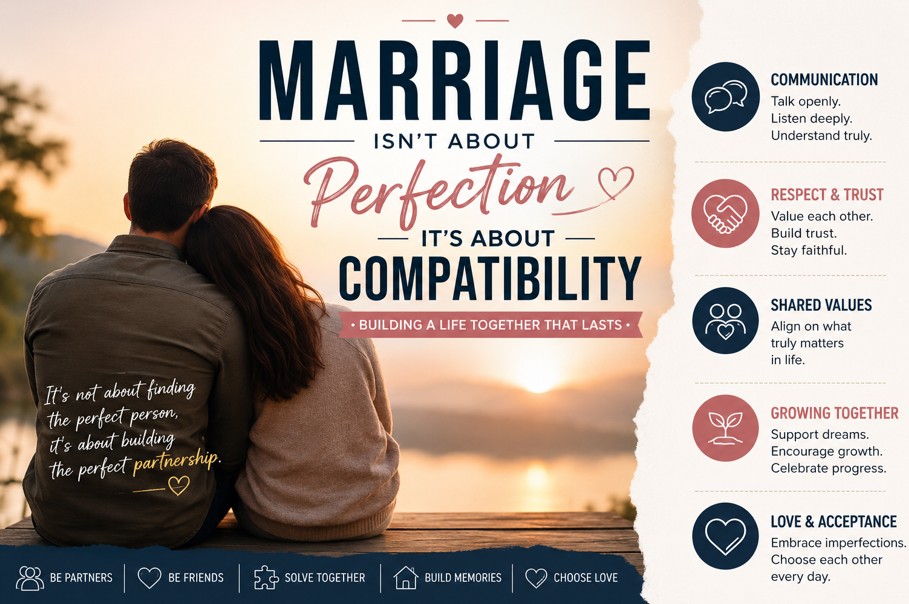
Marriage Isn’t About Perfection—It’s About Compatibility
Introduction
In today’s fast-paced world, many people enter the journey of finding a life partner with a long checklist of expectations. They want someone who is attractive, financially successful, emotionally mature, highly educated, socially respected, family-oriented, and free from flaws. While having standards is important, the pursuit of perfection often becomes the biggest obstacle to finding genuine happiness.
The truth is simple yet profound: marriage isn’t about finding the perfect person; it’s about finding the right person whose values, goals, and personality complement yours. Compatibility—not perfection—is the foundation upon which happy and lasting marriages are built.
Every successful marriage has one thing in common. It is not the absence of disagreements, mistakes, or imperfections. Instead, it is the presence of understanding, respect, patience, trust, and the willingness to grow together despite life’s inevitable challenges.
Many couples who seem “perfect” from the outside struggle behind closed doors, while couples who appear ordinary often enjoy deeply fulfilling relationships because they understand each other on a much deeper level.
This article explores why compatibility matters far more than perfection and how focusing on meaningful connection can lead to a stronger, healthier, and happier marriage.
The Myth of the Perfect Partner
From fairy tales to Hollywood movies and social media, we are constantly surrounded by images of “perfect couples.” We see carefully curated photos, romantic vacations, expensive gifts, smiling faces, and flawless weddings.
What we rarely see are:
- The disagreements
- The compromises
- The financial struggles
- The emotional growth
- The difficult conversations
- The sacrifices
These hidden realities exist in every marriage.
No human being is perfect.
Every person has strengths and weaknesses.
Every individual carries habits that others may find annoying.
Everyone makes mistakes.
Expecting perfection from a spouse is like expecting life without problems—it simply isn’t realistic.
The happiest couples are not those who never encounter difficulties. They are the couples who learn how to navigate challenges together.
What Does Compatibility Really Mean?
Compatibility is often misunderstood.
Many people believe compatibility means:
- Having identical personalities
- Sharing every hobby
- Always agreeing
- Never arguing
None of these are necessary.
Real compatibility means:
- Sharing core values
- Respecting differences
- Supporting each other’s dreams
- Communicating honestly
- Solving conflicts maturely
- Growing together emotionally
Compatibility is about how two imperfect individuals fit together.
Think of two puzzle pieces.
Each piece has unique edges.
Neither is perfect alone.
Together they create something complete.
Marriage works much the same way.
Why Perfection Is Impossible
Perfection doesn’t exist because people constantly evolve.
A person at age 25 is not the same person at age 35.
Priorities change.
Careers change.
Health changes.
Dreams change.
Families grow.
Financial situations improve or decline.
Life continually transforms people.
Even if someone appeared “perfect” today, they would change tomorrow.
Successful marriages embrace change instead of resisting it.
Partners adapt together.
They grow together.
They learn together.
Shared Values Matter More Than Shared Interests
Many couples worry whether they enjoy the same hobbies.
One loves traveling.
The other enjoys staying home.
One likes football.
The other enjoys reading books.
These differences rarely destroy marriages.
What truly matters is sharing fundamental values.
Examples include:
- Honesty
- Faith
- Family priorities
- Financial responsibility
- Respect
- Kindness
- Commitment
- Integrity
Two people with different hobbies but similar values often build stronger marriages than two people with identical hobbies but conflicting principles.
Values determine long-term decisions.
Interests simply determine how weekends are spent.
Communication Creates Compatibility
No couple can read each other’s minds.
Healthy communication bridges differences.
It allows couples to understand each other’s needs, fears, expectations, and emotions.
Strong communication includes:
Listening without interrupting.
Speaking respectfully.
Expressing feelings honestly.
Being willing to apologize.
Finding solutions instead of blaming.
Many marital problems aren’t caused by incompatibility.
They’re caused by poor communication.
When couples communicate openly, even major differences become manageable.
Respect Is More Important Than Romance
Romantic feelings naturally fluctuate.
Life becomes busy.
Children arrive.
Careers demand attention.
Health issues arise.
Stress increases.
During these seasons, respect becomes the glue that holds marriages together.
Respect means:
Speaking kindly.
Appreciating each other’s efforts.
Avoiding humiliation.
Valuing opinions.
Protecting dignity.
Supporting each other publicly and privately.
Love may begin with attraction.
Long-lasting marriage continues through respect.
Emotional Compatibility
Emotional compatibility refers to how couples respond to feelings, stress, disappointment, and happiness.
Questions worth considering include:
Can you comfort each other during difficult times?
Can you celebrate each other’s achievements without jealousy?
Can you discuss problems calmly?
Do you feel emotionally safe together?
Emotional safety is one of the strongest predictors of marital satisfaction.
When spouses feel accepted despite their imperfections, intimacy naturally grows.
Accepting Imperfections
Every spouse brings imperfections into marriage.
Someone may:
Forget birthdays.
Leave clothes on the chair.
Spend too much time working.
Be overly quiet.
Talk too much.
Need personal space.
Become anxious under stress.
These flaws don’t necessarily destroy relationships.
What destroys relationships is refusing to accept that imperfections exist.
Acceptance doesn’t mean tolerating abuse or harmful behavior.
Rather, it means recognizing that ordinary human flaws are part of every relationship.
Conflict Doesn’t Mean Incompatibility
Many couples panic after their first serious disagreement.
They wonder:
“Maybe we’re not meant for each other.”
Conflict is normal.
Even deeply compatible couples argue.
The real question isn’t whether conflict exists.
The important question is:
How do you handle conflict?
Healthy couples:
Stay respectful.
Listen carefully.
Seek solutions.
Forgive mistakes.
Avoid bringing up old arguments.
Work as teammates rather than opponents.
Conflict handled well often strengthens relationships.
Trust: The Invisible Foundation
Compatibility flourishes where trust exists.
Without trust:
Every late phone call creates suspicion.
Every delay becomes a concern.
Every misunderstanding grows larger.
Trust allows peace.
Building trust requires:
Honesty.
Consistency.
Transparency.
Reliability.
Keeping promises.
Trust isn’t built overnight.
It’s built through countless small actions repeated over time.
The Importance of Shared Life Goals
Compatibility becomes stronger when couples move toward similar destinations.
Important discussions before marriage include:
Where do we want to live?
Do we want children?
How should finances be managed?
What role will religion play?
How important is career growth?
How involved should extended family be?
These conversations prevent many future misunderstandings.
Personality Differences Can Be Strengths
Some people are naturally outgoing.
Others are introverted.
One partner plans everything.
The other enjoys spontaneity.
One speaks quickly.
The other thinks before talking.
These differences often complement each other beautifully.
Instead of asking:
“Are we identical?”
Ask:
“Do our differences help us grow?”
Complementary personalities often create balanced marriages.
The Role of Patience
Compatibility develops over time.
Marriage isn’t instant perfection.
It is continuous learning.
Patience allows couples to:
Understand habits.
Adjust expectations.
Develop routines.
Improve communication.
Strengthen friendship.
Years of shared experiences deepen compatibility far beyond what exists on the wedding day.

Friendship Before Everything Else
Many experts describe successful marriages as deep friendships.
Friends:
Enjoy spending time together.
Laugh together.
Support each other.
Respect differences.
Celebrate successes.
Stand together during hardships.
Romance may bring two people together.
Friendship keeps them together.
Financial Compatibility
Money is one of the most common sources of marital conflict.
Compatibility doesn’t require equal income.
It requires shared financial attitudes.
Couples should discuss:
Saving habits.
Spending priorities.
Debt.
Financial goals.
Budgeting.
Generosity.
Transparency about finances creates trust and reduces conflict.
Family Expectations
Marriage joins two individuals and often two families.
Compatibility includes discussing expectations regarding:
Living arrangements.
Visiting parents.
Family traditions.
Cultural practices.
Celebrations.
Boundaries.
Mutual understanding prevents unnecessary tension.
Supporting Each Other’s Growth
Marriage should never stop personal development.
Healthy spouses encourage each other to:
Learn new skills.
Pursue education.
Advance careers.
Improve health.
Strengthen faith.
Develop confidence.
Growth should never threaten a healthy marriage.
Instead, couples celebrate each other’s progress.
Forgiveness Is Essential
Mistakes happen.
Words are spoken in frustration.
Misunderstandings occur.
Disappointments arise.
Without forgiveness, resentment accumulates.
Forgiveness doesn’t erase responsibility.
It allows healing.
Strong marriages repeatedly choose grace over bitterness.
The Power of Appreciation
Many marriages become unhappy not because love disappears but because appreciation disappears.
Simple phrases matter:
“Thank you.”
“I appreciate you.”
“I’m proud of you.”
“You worked hard.”
“You mean a lot to me.”
Regular appreciation reminds spouses that their efforts are seen and valued.
Building Compatibility Every Day
Compatibility isn’t something couples either have or don’t have.
It is built daily.
Every conversation strengthens or weakens connection.
Every act of kindness matters.
Every apology repairs trust.
Every shared meal creates memories.
Every challenge overcome together deepens partnership.
Marriage is a lifelong process of choosing each other repeatedly.
Red Flags That Should Not Be Ignored
Although perfection isn’t necessary, certain issues deserve serious attention before marriage.
These include:
- Dishonesty
- Abuse
- Addiction
- Lack of accountability
- Extreme jealousy
- Manipulation
- Disrespect
- Refusal to communicate
Compatibility cannot overcome persistent harmful behavior without genuine change and accountability.
Healthy relationships require safety and mutual respect.
Why Real Love Accepts Imperfection
Real love sees imperfections clearly.
It simply chooses commitment anyway.
This doesn’t mean ignoring harmful behavior.
It means understanding that ordinary human flaws are universal.
Every wrinkle.
Every mistake.
Every weakness.
Every fear.
These become opportunities for compassion rather than criticism.
Marriage Is a Journey, Not a Destination
The wedding day lasts one day.
Marriage lasts a lifetime.
The happiest couples never stop learning about each other.
They continue asking questions.
They continue dating.
They continue laughing.
They continue growing.
Compatibility deepens with every shared experience.
Practical Ways to Build Compatibility
If you’re preparing for marriage or already married, here are practical ways to strengthen compatibility:
- Prioritize Honest Conversations
Talk openly about expectations, fears, finances, children, career goals, and family responsibilities.
- Practice Active Listening
Listen to understand rather than simply preparing your response.
- Respect Differences
Different opinions don’t automatically threaten love.
- Create Shared Traditions
Weekly dinners, evening walks, monthly outings, or annual trips create lasting memories.
- Continue Learning About Each Other
People change.
Stay curious.
Keep asking questions.
- Solve Problems Together
Treat problems as common enemies—not each other.
- Express Appreciation Frequently
Never assume your spouse knows how much you value them.
Say it often.
- Protect Trust
Small acts of honesty build enormous confidence over time.
- Laugh Together
Humor reduces stress and strengthens emotional connection.
- Never Stop Choosing Each Other
Love is more than emotion.
It is a daily decision.
Lessons from Long-Lasting Marriages
When couples celebrate 30, 40, or even 50 years of marriage, they rarely credit perfection.
Instead, they mention:
“We learned to forgive.”
“We respected each other.”
“We communicated.”
“We stayed together during hard times.”
“We kept our promises.”
“We grew together.”
These qualities reflect compatibility in action.
Growing Together: The Secret Ingredient of a Lasting Marriage
One of the most beautiful aspects of marriage is that it allows two people to grow together over time. When two individuals first get married, they bring different experiences, habits, personalities, and perspectives into the relationship. Instead of expecting everything to fit perfectly from the beginning, successful couples recognize that compatibility is something that evolves through shared experiences, mutual understanding, and continuous effort.
Life is full of changes. Careers develop, families expand, financial situations fluctuate, and personal goals evolve. A couple who learns to adapt together during these transitions often discovers that their bond becomes stronger with each passing year. Compatibility is not a fixed trait; it is a living, growing connection that deepens as partners continue to invest in each other.
Growing together also means encouraging one another to become the best versions of yourselves. A healthy marriage is not about controlling your spouse or expecting them to remain exactly the same throughout life. Instead, it is about supporting each other’s ambitions, celebrating achievements, and providing comfort during setbacks. When one partner succeeds, the other should feel proud rather than threatened. This mutual encouragement creates an environment where both individuals can thrive while strengthening their relationship.
Another important aspect of compatibility is learning how to navigate life’s unexpected challenges as a team. Every marriage will face obstacles, whether they involve financial pressure, health concerns, career changes, or family responsibilities. Couples who approach these difficulties with a “we’re in this together” mindset are more likely to overcome hardships successfully. Instead of blaming one another, they focus on finding solutions, sharing responsibilities, and supporting each other emotionally.
Patience is another quality that helps compatibility flourish. No one learns everything about their spouse in the first few months or even the first few years of marriage. It takes time to understand each other’s communication styles, emotional needs, and personal preferences. Being patient allows couples to replace unrealistic expectations with compassion and understanding. Rather than criticizing small imperfections, they learn to appreciate the unique qualities that make their partner who they are.
It is equally important to maintain individuality within marriage. Compatibility does not require two people to lose their identities or give up their personal interests. Healthy couples respect each other’s hobbies, friendships, and personal goals while continuing to nurture their relationship. Having individual passions can actually enrich a marriage by bringing fresh experiences, conversations, and perspectives into the partnership. A balanced relationship gives both spouses the freedom to grow independently while remaining deeply connected.
Gratitude also plays a powerful role in building compatibility. Over time, it is easy to take a spouse’s daily efforts for granted. Small gestures such as preparing meals, managing household responsibilities, working hard for the family’s future, or simply offering emotional support deserve recognition. Expressing sincere appreciation reminds your partner that their contributions matter. A simple “thank you” or “I appreciate everything you do” can strengthen emotional intimacy and reinforce feelings of love and respect.
Compatibility also grows through shared memories. Traveling together, celebrating milestones, overcoming challenges, raising children, supporting aging parents, or simply enjoying quiet evenings at home all contribute to a couple’s unique story. These shared experiences create a strong emotional foundation that cannot be measured by appearances or material possessions. Years later, couples often remember the moments they laughed together, comforted each other during difficult times, and achieved their dreams side by side.
Ultimately, a successful marriage is not about finding someone who is flawless—it is about finding someone who is willing to build a meaningful life with you despite life’s imperfections. Compatibility is strengthened every time you choose patience over anger, understanding over judgment, forgiveness over resentment, and partnership over pride. These everyday choices may seem small, but over the years they create a relationship built on trust, respect, and enduring love.
When people shift their focus from searching for perfection to cultivating compatibility, they discover a more realistic and fulfilling view of marriage. A lasting relationship is not created by chance; it is built intentionally through kindness, commitment, communication, and shared growth. In the end, the happiest couples are not those who never face challenges—they are the ones who face every challenge together, hand in hand, knowing that their greatest strength lies not in being perfect, but in being perfectly committed to one another.

Perfection
Marriage is one of life’s most meaningful partnerships, but it is often misunderstood. Many people spend years searching for someone who checks every box, believing that happiness lies in finding a flawless spouse. In reality, lasting marriages are not built on perfection—they are built on compatibility.
Compatibility is the quiet strength that allows two imperfect people to face life together with understanding, patience, and mutual respect. It is found in shared values, honest communication, emotional safety, trust, and a willingness to support each other’s growth. These qualities create a relationship that can withstand disagreements, adapt to life’s changes, and grow stronger through every season.
Perfection is an illusion. Every individual has weaknesses, habits, fears, and moments of failure. What truly matters is finding someone who is willing to grow, listen, forgive, and stand beside you through both joy and hardship. A compatible partner is not someone who never makes mistakes, but someone whose heart, intentions, and commitment align with yours.
Whether you are searching for a life partner or nurturing an existing marriage, remember that love is not measured by the absence of flaws. It is measured by the ability to embrace each other’s imperfections while continually choosing kindness, respect, and understanding.
At the end of the day, the strongest marriages are not between two perfect people. They are between two people who recognize that perfection is impossible, but compatibility, commitment, and genuine love can create a beautiful life together.
Choose compatibility over perfection, and you’ll build a marriage that is not only lasting but deeply fulfilling.