



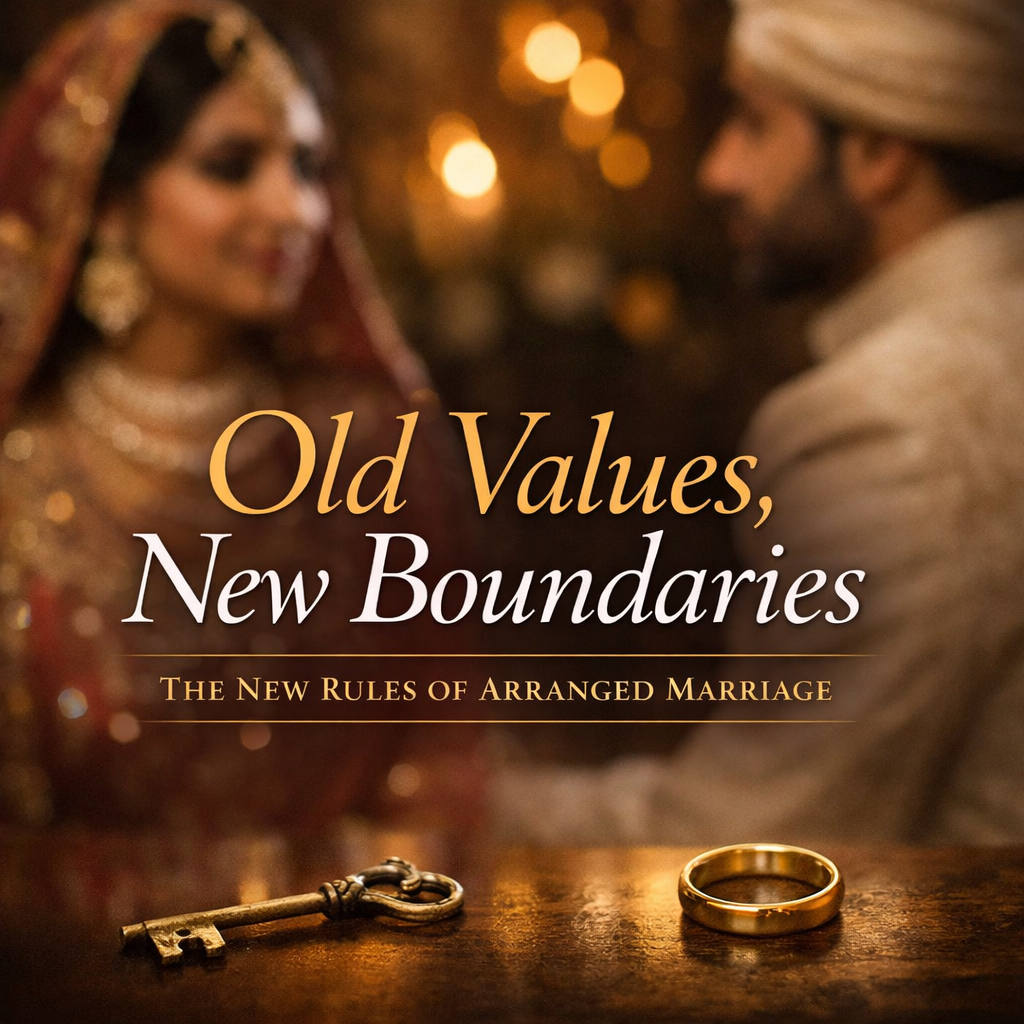
Old Values, New Boundaries: The New Rules of Arranged Marriage
For generations, arranged marriage was simple—at least on the surface. Families met. Backgrounds were checked through relatives and reputation. Compatibility meant religion, family status, education, and “good character.” Decisions were made quickly, often with minimal emotional input from the bride or groom. Stability mattered more than self-expression. Silence was considered maturity.
Today, that structure still exists—but it no longer works in the same way.
Arranged marriage hasn’t disappeared. In fact, in many parts of South Asia and among elite urban families, it has quietly evolved into something far more complex, nuanced, and emotionally demanding. What has changed is not the value system at its core, but the boundaries around choice, consent, privacy, emotional readiness, and individual identity.
We are now living in an era where old values still matter—but old rules don’t.
This article explores how arranged marriage has transformed, what boundaries modern individuals are setting, and why understanding these “new rules” is essential for families, matchmakers, and individuals who want marriages that actually last.
Arranged Marriage Was Never the Enemy
There is a popular narrative—especially online—that paints arranged marriage as outdated, oppressive, or incompatible with modern life. This view is simplistic and often disconnected from reality.
Arranged marriage, at its best, was never about control. It was about community trust, risk reduction, and long-term stability. Families acted as filters. Elders assessed character through lived experience. Marriage wasn’t treated as a romantic experiment—it was treated as a lifelong institution.
What failed wasn’t the concept.
What failed was the refusal to adapt.
As society changed—education levels rose, women entered the workforce, migration increased, emotional awareness grew—the old structure began to clash with new realities. But instead of replacing arranged marriage, people quietly rewrote its rules.
The Core Values That Still Matter
Despite all the changes, some values remain non-negotiable in arranged marriages—even among the most progressive families.
- Family Background Still Counts
Not because of status alone, but because family culture shapes conflict resolution, expectations, and emotional behavior. How a family handles disagreement, privacy, money, and gender roles still predicts marital stability.
- Character Over Charm
Charm fades. Social media personas lie. Families still prioritize integrity, responsibility, and consistency—traits that don’t trend online but matter deeply offline.
- Long-Term Thinking
Arranged marriages still ask questions love marriages often delay:
- How will this work in 10 years?
- How will families interact?
- How will children be raised?
- How will crises be handled?
These values remain powerful—and necessary.
But here’s the shift: values are no longer enforced without consent.
Boundary #1: Choice Is No Longer Optional
In the past, agreement was often assumed. Silence meant yes. Obedience was mistaken for maturity.
Today, choice is explicit.
Modern arranged marriage only works when both individuals:
- Actively consent
- Are allowed to say no without punishment
- Are involved early, not informed late
Families may still shortlist, suggest, and guide—but they no longer decide alone. Even in conservative households, forced agreement is increasingly seen as risky, not respectable.
A marriage that begins with suppressed resistance almost always collapses later—emotionally, if not legally.
Boundary #2: Emotional Compatibility Is No Longer Ignored
Earlier generations believed emotional understanding would “grow with time.” Sometimes it did. Often, people simply learned to tolerate unhappiness quietly.
Modern individuals are no longer willing to gamble their emotional lives.
They now ask:
- Can we communicate without fear?
- Can we disagree without humiliation?
- Do we feel emotionally safe?
- Are our attachment styles compatible?
This doesn’t mean romance has replaced responsibility. It means emotional health has joined the checklist.
Arranged marriage is no longer just a social contract. It is an emotional partnership—and emotional mismatches are now considered legitimate deal-breakers.
Boundary #3: Privacy Has Become Sacred
One of the biggest changes in arranged marriage is the treatment of privacy.
Previously:
- Biodata circulated freely
- Personal details were discussed openly
- Rejections became family gossip
- Multiple people had access to sensitive information
Today, privacy is not a luxury—it is a requirement.
Modern families and individuals demand:
- Confidential profile handling
- Limited information sharing
- Controlled communication
- Discretion in rejection
Why? Because reputation, dignity, and emotional safety matter more than speed.
This is one reason why curated, confidential marriage media are replacing open platforms. People don’t want visibility. They want precision.
Boundary #4: Timelines Are Personal, Not Social
“Biye kobe?” used to be a harmless question. Now it’s pressure disguised as concern.
Modern arranged marriage respects that:
- Readiness is not age-based
- Career phases matter
- Emotional healing takes time
- Financial independence changes timelines
Forcing marriage before emotional readiness leads to silent resentment later.
Today’s new rule:
A delayed marriage is healthier than a rushed one.
Families are slowly learning that waiting is not failure—it is preparation.
Boundary #5: Gender Roles Are Being Renegotiated
Old arranged marriages operated on rigid roles:
- Men provided
- Women adjusted
- Sacrifice was one-sided
That model no longer holds—especially among educated, urban families.
Modern arranged marriage discussions now include:
- Career expectations after marriage
- Division of household responsibilities
- Living arrangements
- Financial transparency
- Emotional labor
This doesn’t mean tradition is rejected. It means roles are discussed instead of assumed.
Assumption is the fastest way to conflict. Conversation is the new tradition.
Boundary #6: Families Are Involved—but Not Intrusive
Earlier, marriage meant merging families completely, often at the cost of the couple’s autonomy.
Today’s couples want:
- Respectful involvement, not control
- Support, not surveillance
- Guidance, not micromanagement
Families are still central—but boundaries exist.
Healthy arranged marriages now operate on a triangle:
- Individual autonomy
- Couple’s space
- Family connection
When one dominates the others, imbalance begins.
Boundary #7: Background Checks Have Gone Professional
In the past, background checks relied on relatives and social circles. That worked—until people moved cities, countries, and digital lives.
Modern arranged marriage requires:
- Financial transparency
- Employment verification
- Marital history clarity
- Lifestyle honesty
This isn’t distrust. It’s realism.
People no longer believe “family reputation” alone guarantees personal behavior. Verification is seen as respect—not suspicion.
Boundary #8: Rejection Is No Longer an Insult
Old systems treated rejection as shameful. A rejected proposal damaged ego, family pride, and social standing.
Today’s rule is different:
- Rejection is part of alignment
- Silence is replaced with courtesy
- “No” is not a personal attack
Emotionally mature arranged marriages normalize rejection as filtering, not failure.
This mindset reduces bitterness and increases long-term success.
Why Arranged Marriage Still Works—When Updated
Arranged marriage succeeds today not because people are obedient, but because:
- Filtering is smarter
- Choices are respected
- Emotional intelligence is prioritized
- Privacy is protected
- Boundaries are clear
It blends structure with sensitivity.
In many ways, modern arranged marriage is more demanding than love marriage. It requires:
- Self-awareness
- Communication skills
- Emotional honesty
- Family diplomacy
But when done right, it offers something rare: intentional partnership.
The Role of Modern Marriage Media
This evolution didn’t happen on its own.
Modern marriage media now act as:
- Gatekeepers of privacy
- Interpreters between generations
- Emotional buffers
- Verification systems
- Pace regulators
They don’t just match profiles. They manage expectations, boundaries, and dignity.
This is especially important in elite or high-profile circles, where visibility can be damaging and mistakes are costly.
Old Values, New Wisdom
The future of arranged marriage does not lie in rebellion against tradition.
It lies in refinement.
Respect without rigidity.
Family without force.
Commitment without control.
Old values taught us loyalty, patience, and responsibility.
New boundaries teach us consent, communication, and emotional safety.
Together, they create marriages that are not just socially acceptable—but personally sustainable.
Final Thought
Arranged marriage didn’t fail modern society.
Modern society simply demanded more from it.
And in response, arranged marriage evolved—quietly, intelligently, and with far more emotional depth than it’s ever been given credit for.
If we stop judging it by outdated rules and start understanding its new boundaries, we may realize something surprising:
Old Values, New Boundaries: The New Rules of Arranged Marriage
One of the least discussed realities of modern arranged marriage is this:
Most people entering it are no longer blank slates.
They come with:
- established careers
- defined lifestyles
- emotional histories
- personal boundaries
- a sense of identity shaped outside family control
Earlier generations married before becoming fully formed individuals. Today, people marry after they already know who they are—or at least who they refuse to be.
This shift alone has rewritten everything.
Arranged marriage now operates in a psychologically crowded space, where tradition must negotiate with individuality rather than overwrite it.
The Rise of the “Internally Negotiated” Marriage
Earlier arranged marriages were externally negotiated:
- Families decided compatibility
- Elders set expectations
- Individuals adapted
Modern arranged marriages are internally negotiated first.
People now enter proposals asking themselves:
- “Can I be myself here?”
- “What will I lose if I say yes?”
- “What parts of my life must shrink to fit this marriage?”
This internal dialogue is not rebellion—it’s maturity.
The new boundary is clear:
No marriage is worth erasing the self.
Why Adjustment Is No Longer a Virtue Without Limits
“Adjust kore nite hobe” used to be marital wisdom.
But modern individuals have seen what unlimited adjustment costs:
- emotional burnout
- silent resentment
- identity loss
- generational trauma
Adjustment without boundaries is no longer respected—it’s questioned.
Today’s arranged marriage allows adjustment only when it is:
- mutual
- conscious
- temporary
- non-destructive
Sacrifice still exists—but it is no longer one-sided or endless.
The Fear Families Rarely Admit: Losing Influence
One reason older generations struggle with modern arranged marriage is fear—though it’s rarely named.
Not fear of bad matches.
Fear of losing authority.
When individuals:
- choose timing
- negotiate roles
- reject proposals
- demand privacy
Families feel their influence slipping.
But the truth is this:
Influence that relies on control was never stable.
Modern arranged marriage is forcing families to evolve from decision-makers to advisors. Those who adapt build trust. Those who resist create distance.
Why “Good on Paper” Matches Collapse Emotionally
One of the biggest failures of semi-modern arranged marriages is over-reliance on credentials.
Education.
Salary.
Family name.
Location.
Everything aligns—yet something feels wrong.
Why?
Because emotional rhythm was never examined.
Modern marriages fail not because people are incompatible, but because:
- one avoids conflict, the other confronts
- one needs reassurance, the other needs space
- one processes slowly, the other reacts fast
These mismatches don’t appear on biodata—but they dominate daily life.
The new rule:
Emotional styles matter more than social symmetry.
The Quiet Power Shift: Women Are No Longer Negotiable Assets
In older arranged marriage systems, women were adjusted into marriages.
Today, educated, financially independent women are redefining the structure entirely.
They now ask:
- Will my career pause—or continue?
- Will motherhood be assumed—or discussed?
- Will my opinions be tolerated—or dismissed?
- Will marriage expand my life—or shrink it?
Families who treat these questions as threats lose strong matches. Families who treat them as dialogue gain resilient marriages.
Arranged marriage now survives because women refuse to disappear inside it.
Men Are Also Setting Boundaries—Quietly
While much attention goes to women’s autonomy, modern arranged marriage has also changed men—just less visibly.
Men now feel pressure to:
- emotionally perform
- financially exceed
- socially impress
- remain endlessly stable
Many men are exhausted by expectations they never agreed to.
Modern men are beginning to say:
- “I don’t want a marriage built on pressure.”
- “I want partnership, not performance.”
- “I want emotional safety too.”
This is reshaping masculinity inside arranged marriage—from provider-only to participant.
Marriage Is No Longer an Escape Route
Earlier generations often married to escape:
- parental control
- financial instability
- social scrutiny
Today, marriage is rarely an escape. Most people already live independently.
So the question changes from:
“Will this improve my situation?”
to
“Will this improve my life?”
If the answer is unclear, hesitation follows—and hesitation is no longer treated as weakness.
Why Speed Is Now Seen as Risky, Not Efficient
Quick decisions were once praised in arranged marriage.
Now, speed raises suspicion.
Why the rush?
What’s being hidden?
Why can’t this wait?
Modern arranged marriage understands:
- Slow conversations prevent fast divorces
- Time reveals emotional patterns
- Patience filters desperation
Efficiency has been replaced by intentional pacing.
The New Meaning of Compatibility
Compatibility once meant:
- same religion
- similar family background
- acceptable age gap
Now it includes:
- conflict style
- emotional availability
- ambition alignment
- lifestyle preferences
- boundaries with extended family
Compatibility has moved from surface alignment to daily-life survivability.
Why Love Is No Longer Promised—but Emotional Safety Is
Modern arranged marriage no longer guarantees love.
It offers something more realistic—and often more valuable:
- respect
- emotional safety
- shared values
- room to grow
Love may develop. Or it may deepen slowly.
But fear, control, and silence are no longer acceptable foundations.
The Role of Silence Has Changed
Earlier, silence meant patience.
Now, silence often signals:
- avoidance
- emotional shutdown
- unresolved conflict
Modern marriages reward articulation, not endurance.
The ability to speak without fear has become more important than the ability to tolerate discomfort.
When Families Get It Right
Some families are doing this beautifully.
They:
- introduce, then step back
- listen more than they lecture
- protect privacy
- allow rejection without shame
- prioritize emotional fit over urgency
These families don’t lose control—they gain trust.
Their marriages last not because of pressure, but because of alignment.
Why Modern Arranged Marriage Is Emotionally Harder—but Healthier
Let’s be honest.
Modern arranged marriage is not easier.
It demands:
- self-awareness
- emotional honesty
- difficult conversations
- boundary enforcement
But it produces marriages where:
- resentment is reduced
- identity is preserved
- communication exists
- respect is mutual
Hard work upfront prevents lifelong repair later.
The Quiet Truth No One Says Aloud
Many people entering arranged marriage today are not afraid of commitment.
They are afraid of miscommitment.
They’ve seen marriages where:
- people stayed but died emotionally
- families won but individuals lost
- appearances survived while intimacy collapsed
Modern boundaries exist to prevent these outcomes—not to rebel against tradition.
Arranged Marriage Has Become a Filter, Not a Force
This may be the most important shift of all.
Arranged marriage no longer pushes people together.
It filters people out.
It removes:
- misalignment
- unrealistic expectations
- incompatible values
And what remains has a better chance of lasting.
Closing Reflection: Tradition Didn’t Break—It Matured
Arranged marriage today is not weaker than before.
It is more conscious.
More selective.
More emotionally literate.
Old values gave us structure.
New boundaries gave us dignity.
Together, they offer something rare in modern relationships:
a marriage chosen carefully, not blindly—supported by family, not controlled by it.
Arranged marriage didn’t survive by resisting change.
It survived by learning where tradition ends—and where human boundaries must begin.
The Boundary That Matters Most: Self-Respect
Perhaps the most important new rule of arranged marriage is the quietest one: self-respect is no longer negotiable.
In the past, dignity was often linked to endurance—how much one could tolerate without complaint. Today, dignity is defined by clarity. By the ability to say, “This doesn’t feel right,” without guilt. By knowing that walking away from the wrong marriage is not failure, but wisdom.
Modern arranged marriage has taught people to listen to discomfort early, rather than normalize it later. It has replaced blind optimism with conscious hope. People no longer marry with the promise that things will “somehow work out.” They marry only when effort, respect, and intention are visible on both sides.
This shift has quietly reduced emotional damage—even if it has increased the time it takes to say yes.
The success of arranged marriage today is not measured by how fast proposals move, but by how thoughtfully they pause. Boundaries slow the process, but they protect the people inside it.
And in that pause—where old values meet new self-awareness—modern arranged marriage finds its most honest form yet.