





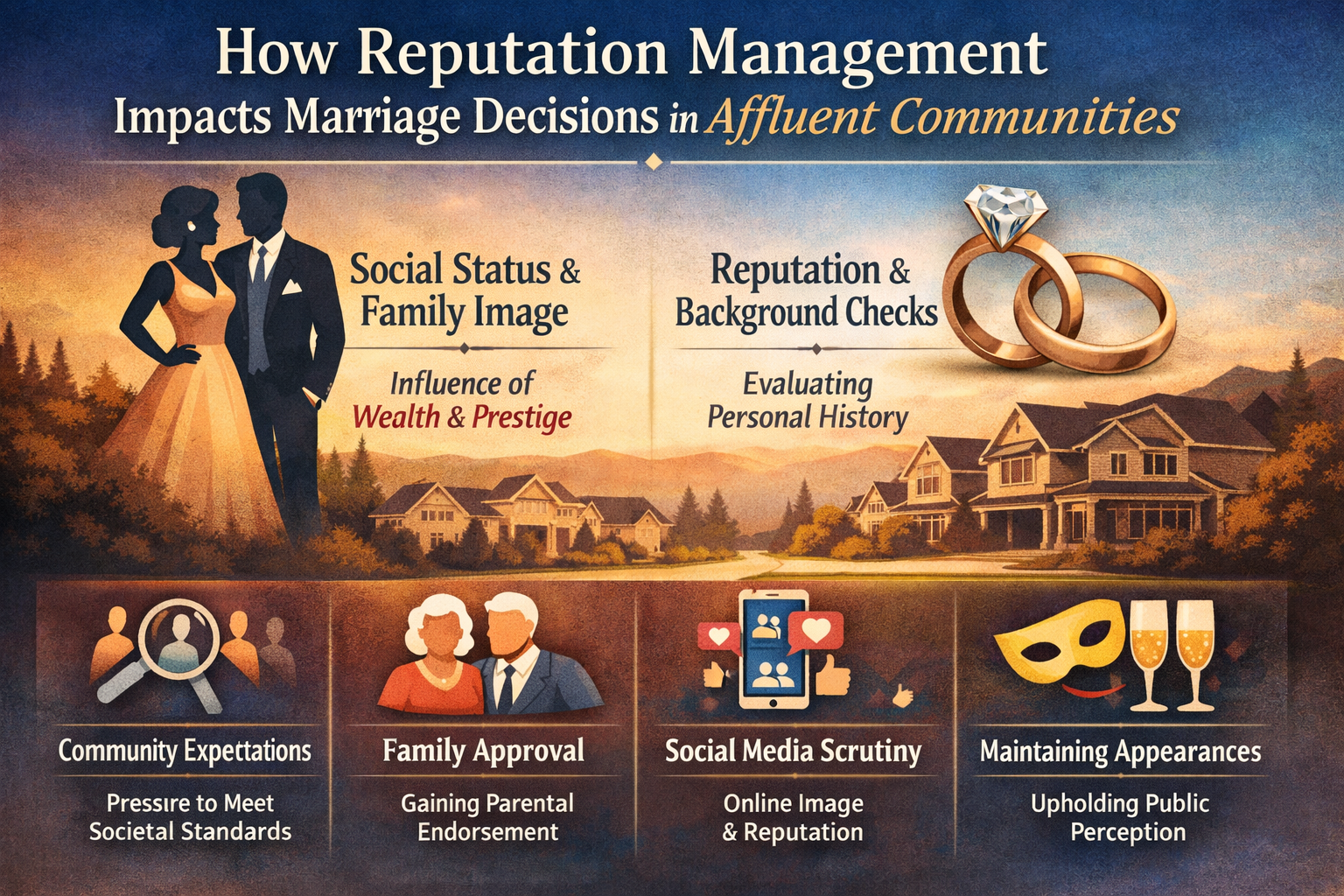
How Reputation Management Impacts Marriage Decisions in Affluent Communities
A Deep Insight into Elite Matchmaking Culture in Gulshan, Banani & Baridhara
Introduction: Marriage Beyond Emotion in Elite Society
In affluent communities, marriage is rarely just about two individuals choosing each other. It is often a complex decision influenced by family legacy, business interests, social standing, and long-term reputation. While love, compatibility, and personal preferences remain important, another powerful factor silently shapes decisions — reputation management.
In elite areas such as Gulshan, Banani, and Baridhara, families operate within tightly connected social networks. Business leaders, corporate executives, diplomats, politicians, and high-net-worth individuals interact in the same circles. News travels fast. Perceptions matter. Image carries weight.
In this environment, marriage is not just a personal milestone; it is a social and reputational event.
This article explores how reputation management deeply influences marriage decisions in affluent communities, why families prioritize image protection, and how modern matchmaking services navigate this delicate balance.
- Understanding Reputation as Social Capital
In affluent communities, reputation functions as social capital.
It is built over time through:
- Business integrity
- Professional credibility
- Ethical conduct
- Social behavior
- Educational achievements
- Community involvement
- Family legacy
A strong reputation creates trust. Trust opens doors to business opportunities, social invitations, and strategic alliances. Marriage, therefore, becomes one more extension of that trust network.
Families ask:
- Does this alliance enhance or weaken our standing?
- Will this relationship bring positive association?
- Could there be hidden reputational risks?
Reputation is not only about wealth. It is about perception. A wealthy family with legal disputes may carry weaker reputational value than a moderately wealthy but respected family.
- Marriage as a Strategic Social Alliance
In affluent societies, marriage often resembles a strategic alliance.
Historically, powerful families formed alliances to strengthen economic, political, or social influence. While modern society emphasizes individual choice, elite communities still consider marriage as a long-term partnership between families.
Before accepting a proposal, families may discreetly investigate:
- Financial stability
- Business history
- Legal background
- Media exposure
- Social behavior
- Family dynamics
This is not necessarily distrust. It is risk management.
In high-profile environments, even small controversies can affect broader networks. Therefore, families act cautiously.
- The Culture of Silent Background Verification
Unlike middle-income communities where focus may stay on income and education, affluent families conduct deeper verification.
This can include:
- Checking court records
- Reviewing corporate filings
- Observing lifestyle patterns
- Consulting mutual contacts
- Assessing online presence
These investigations are rarely public. They are handled discreetly to maintain dignity.
Reputation management here serves two purposes:
- Protecting one’s own family image
- Avoiding association with hidden liabilities
In some cases, professional matchmaking services assist in conducting structured background checks before presenting profiles.
- The Role of Social Media in Modern Reputation
In today’s digital world, reputation extends beyond drawing rooms into online platforms.
Families may review:
- Instagram posts
- Facebook activity
- LinkedIn consistency
- Tagged photographs
- Public opinions
- Political statements
A single controversial post can create doubt.
For example:
- Frequent party exposure may signal instability.
- Aggressive political commentary may indicate future conflict.
- Inconsistent career information may raise trust issues.
In affluent communities, controlled digital presence is admired. Overexposure often raises concerns about discretion.
- Image Pressure in High-Status Circles
Elite communities operate under social observation.
Families attend:
- High-profile weddings
- Charity events
- Business conferences
- Social club gatherings
In such environments, public image becomes part of identity.
Marriage decisions must align with that image.
If a conservative family accepts a proposal from someone known for controversial lifestyle choices, it may create tension within their circle.
Thus, reputation management shapes not only who is chosen, but who is avoided.
- Business Reputation and Marriage
In affluent communities, many families own businesses.
Marriage decisions may indirectly influence:
- Investor confidence
- Brand image
- Corporate relationships
- Political alliances
If a family member marries into a household facing financial scandals or unresolved legal issues, it can raise questions.
Even if the individuals are compatible, reputational risk may lead to hesitation.
Marriage, in this context, intersects with brand protection.
- Generational Differences in Reputation Sensitivity
There is often a generational gap.
Parents may prioritize:
- Stability
- Family legacy
- Community respect
Children may prioritize:
- Emotional compatibility
- Shared interests
- Personal growth
This creates tension.
Younger individuals sometimes feel restricted by image-based decision-making, while parents fear long-term consequences of ignoring reputation.
Professional matchmakers often act as mediators, balancing emotional needs with social realities.
- Confidential Matchmaking as Reputation Protection
Affluent families usually avoid open matrimonial platforms.
Reasons include:
- Privacy concerns
- Fear of gossip
- Controlled biodata sharing
- Protection from public rejection
Confidential matchmaking services offer:
- Verified profiles
- Discreet introductions
- Limited circulation of personal data
- Background verification
In elite communities, privacy itself is part of reputation.
A proposal rejected publicly may cause embarrassment. Therefore, controlled communication is preferred.
- The Long-Term Impact of Scandals
Affluent communities rarely forget scandals.
Examples include:
- Public divorce disputes
- Business fraud allegations
- Viral controversies
- Legal battles
Even if legally resolved, social memory can persist.
Families may delay marriage negotiations until reputational stability is restored.
Rebuilding reputation may involve:
- Resolving disputes legally
- Reducing public exposure
- Engaging in philanthropic work
- Maintaining low-profile lifestyle
Reputation recovery takes time.
- Psychological Impact on Individuals
Reputation pressure affects young individuals emotionally.
They may experience:
- Anxiety about public perception
- Fear of family disappointment
- Pressure to marry within status boundaries
- Concern about social judgment
Some may suppress personal choices to protect family image.
Others may rebel against strict reputation-based criteria.
Both extremes create emotional stress.
Balanced decision-making becomes essential.
- Gender and Reputation Scrutiny
In many affluent societies, reputation standards are unequal.
Women often face scrutiny regarding:
- Past relationships
- Social presence
- Lifestyle choices
- Public behavior
Men are often judged more on:
- Financial stability
- Leadership ability
- Business strength
Though society is evolving, reputation sensitivity still affects women more intensely in marriage evaluations.
This imbalance influences proposal acceptance rates.
- Overseas Proposals and Reputation Risks
When proposals come from abroad, verification becomes complex.
Families consider:
- Immigration status
- Employment authenticity
- Hidden marital history
- Legal standing
Without proper verification, risks increase.
Affluent families often prefer trusted intermediaries to validate overseas profiles.
Reputation risk multiplies when information gaps exist.
- Negotiation Power and Reputation
Strong reputation increases negotiation strength.
Families with:
- Clean public record
- Stable financial standing
- Strong social networks
often hold higher influence during discussions.
Conversely, families with controversies may accept compromises.
Reputation becomes invisible leverage.
- Digital Permanence and Future Trends
In the modern era:
- News archives are searchable
- Social media footprints are permanent
- Public records are accessible
Young individuals in affluent communities must understand that digital actions today can affect marriage prospects tomorrow.
Reputation management now includes:
- Responsible online behavior
- Privacy awareness
- Avoiding public conflicts
- Maintaining professional consistency
Digital identity is becoming part of matrimonial evaluation.
- Building a Healthy Reputation-Conscious Strategy
Reputation should not dominate marriage decisions entirely. But it cannot be ignored.
Healthy approach includes:
- Maintaining clean legal and financial standing
- Practicing digital discipline
- Using confidential matchmaking channels
- Prioritizing emotional compatibility alongside status
- Encouraging transparent communication
Marriage succeeds when reputation and compatibility align.
If image becomes more important than character, long-term dissatisfaction may occur.
In affluent communities, reputation management significantly impacts marriage decisions.
It influences:
- Proposal acceptance
- Family negotiations
- Social positioning
- Business relationships
- Long-term alliances
However, reputation alone cannot sustain marriage.
A perfect public image does not guarantee emotional harmony.
The most successful marriages in elite communities emerge when:
- Background verification is thorough
- Privacy is respected
- Reputation is protected
- Emotional intelligence is valued
- Families prioritize long-term compatibility
Marriage is both a personal journey and a social institution. In affluent societies, managing reputation carefully while preserving authenticity is the key to making wise, balanced decisions.
How Reputation Management Impacts Marriage Decisions in Affluent Communities
(Extended Premium Insight for Authority-Level Content)

- The Economics of Reputation in Marriage
In affluent communities, reputation is not only social — it is economic.
A respected family name can:
- Attract business partnerships
- Strengthen political connections
- Increase trust in negotiations
- Enhance brand value
- Create investment opportunities
When marriage discussions begin, families subconsciously calculate how the alliance may affect their economic ecosystem.
For example:
If a well-known corporate family connects with another reputable business house, their association may create new collaborations. Investors often perceive family alliances as indicators of stability and trustworthiness.
On the other hand, if a family with financial disputes or public controversies enters the equation, it may introduce uncertainty.
Thus, reputation functions as financial capital — and marriage decisions often reflect that reality.
- The Influence of Social Circles and Elite Networks
Affluent communities often operate within closed networks.
Members meet at:
- Private clubs
- Diplomatic events
- Business chambers
- Charity galas
- International schools
- Luxury weddings
In such interconnected environments, a single rumor can circulate rapidly.
Because social distance is small, families become highly cautious about new associations.
Marriage therefore becomes a public signal. It announces:
“This family aligns with that family.”
The message is subtle but powerful.
Reputation management ensures that the signal sent to society is positive and stable.
- The Fear of Social Downgrading
One hidden factor influencing marriage decisions in affluent communities is the fear of perceived social downgrading.
Families worry:
- Will this alliance lower our perceived status?
- Will people question our decision?
- Are we compromising our standards?
Sometimes, excellent matches are rejected not because of incompatibility, but because the other family’s social standing is slightly lower.
This mindset reflects status anxiety — a common phenomenon in high-status communities.
Reputation management becomes defensive:
Families try to avoid decisions that may invite criticism from their circle.
- Private Investigations and Discreet Intelligence Gathering
In many affluent societies, background verification is systematic.
This can include:
- Informal inquiries through mutual contacts
- Business reputation checks
- Cross-verifying educational claims
- Reviewing professional performance history
- Investigating lifestyle consistency
These checks are rarely aggressive; they are subtle.
Why?
Because reputation damage can occur even from asking direct questions publicly.
Therefore, investigations are conducted privately to protect both sides.
This silent evaluation process significantly shapes acceptance or rejection.
- Reputation and Divorce Sensitivity
Divorce in affluent communities carries reputational implications, though attitudes are evolving.
Families may examine:
- Reason for divorce
- Public handling of separation
- Legal disputes
- Child custody matters
- Financial settlements
If a divorce involved public drama or legal battles, it may create hesitation in new proposals.
However, if separation was handled maturely and discreetly, reputation remains largely intact.
This shows that reputation is not about perfection — it is about conduct.
How situations are managed matters more than the situation itself.
- The Role of Media Exposure
In the digital era, media visibility influences marriage decisions.
Families may review:
- News mentions
- Television appearances
- Online interviews
- Public speeches
- Business features
Positive media presence enhances credibility.
Negative press, even if old, can resurface during negotiations.
Search engines rarely forget.
Thus, affluent families increasingly monitor their digital reputation.
Marriage discussions often include reviewing online search results before moving forward.
- Philanthropy as Reputation Strengthening
Many elite families actively engage in philanthropy.
Charitable involvement builds moral credibility.
Participation in:
- Educational foundations
- Health initiatives
- Community development programs
- Religious institutions
creates positive perception.
During marriage negotiations, philanthropic work indirectly strengthens reputation.
It signals:
- Responsibility
- Compassion
- Stability
- Community respect
Reputation management, therefore, is not only about avoiding negatives — it is about building positives.
- Emotional Cost of Image-Based Decisions
While reputation protection offers stability, it may create emotional cost.
Young individuals sometimes feel that:
- Their personal desires are secondary
- Family image outweighs compatibility
- They must “perform” perfection
This pressure can lead to:
- Delayed marriage
- Secret relationships
- Emotional dissatisfaction
- Internal family conflict
Balancing social expectations with personal happiness becomes challenging.
Affluent communities often struggle with this silent tension.
- Reputation and Cultural Compatibility
In elite neighborhoods, families often emphasize cultural alignment.
This includes:
- Religious practice level
- Lifestyle expectations
- Social etiquette
- Language proficiency
- International exposure
Cultural mismatch may create future embarrassment in social gatherings.
Therefore, reputation management includes assessing whether both families will comfortably interact in public events.
Compatibility is not only personal — it is performative within society.
- Privacy as a Luxury
In affluent communities, privacy is a luxury asset.
Publicly advertising matrimonial intentions can attract:
- Gossip
- Opportunistic proposals
- Social speculation
Hence many elite families prefer:
- Closed-circle matchmaking
- Personal referrals
- Professional confidential services
Reputation management includes controlling information flow.
The fewer people involved, the lower the risk of reputational exposure.
- The Role of Professional Matchmakers in Image Protection
Professional matchmaking services in elite areas serve as reputation shields.
They:
- Filter unsuitable proposals
- Verify background quietly
- Maintain confidentiality
- Prevent public rejection
- Control communication pace
This reduces emotional and reputational damage.
When discussions fail, they end discreetly without social embarrassment.
Such services are not merely connectors; they are reputation managers.
- Intergenerational Legacy and Long-Term Thinking
Affluent families think in generational timelines.
Marriage is evaluated not only for present compatibility but future legacy.
Questions include:
- How will this alliance affect grandchildren’s opportunities?
- Will family businesses merge?
- Will social networks expand?
- Will political connections strengthen?
Reputation management becomes long-term strategic planning.
Marriage is seen as a generational investment.
- The Impact of Political Associations
In some affluent communities, political ties influence reputation.
If a family has strong political alignment, marrying into a family with opposing affiliations may create tension.
This does not always lead to rejection, but it increases scrutiny.
Political controversy carries reputational risk.
Therefore, political neutrality or stability is often preferred.
- Global Exposure and Reputation Complexity
Many affluent families have international exposure.
Children study abroad, work in multinational corporations, and live globally.
This creates additional layers of evaluation:
- Cross-cultural adaptability
- Immigration credibility
- Lifestyle compatibility
- Reputation abroad
A mismatch between local image and international lifestyle may raise concerns.
Families want alliances that enhance global positioning.
- Reputation vs Authenticity
One of the most complex tensions in affluent marriage decisions is the balance between reputation and authenticity.
If image becomes too dominant, individuals may:
- Hide personal struggles
- Conceal past mistakes
- Suppress individuality
However, authenticity builds long-term trust.
Families gradually recognize that controlled transparency is healthier than artificial perfection.
A spotless but emotionally incompatible alliance rarely survives long-term.
- Social Comparison and Competitive Pressure
Affluent communities often experience subtle competition.
Families compare:
- Wedding scale
- Venue prestige
- Guest list influence
- Jewelry display
- International travel
Marriage decisions can sometimes reflect competitive pride.
Reputation management then shifts from protection to projection.
This competitive environment may distort priorities.
Wise families focus on stability rather than spectacle.
- Crisis Management Before Marriage
If a family recently experienced:
- Financial loss
- Legal dispute
- Public scandal
they may delay marriage discussions until stability returns.
Timing matters.
Reputation recovery before alliance prevents negative perception.
This shows how dynamic reputation management is — it adapts to circumstances.
- The Psychological Need for Social Approval
Humans seek belonging.
In elite communities, belonging requires maintaining standards.
Marriage decisions often aim to secure approval from:
- Extended relatives
- Business partners
- Social peers
Fear of criticism influences acceptance.
This psychological factor makes reputation powerful.
- Changing Trends Among Modern Elites
Younger affluent generations are gradually redefining reputation.
They prioritize:
- Emotional intelligence
- Shared values
- Mental health awareness
- Gender equality
- Transparency
While family image still matters, personal happiness is gaining importance.
Future affluent marriages may balance reputation with emotional compatibility more effectively.
- Sustainable Reputation Strategy in Marriage Decisions
A healthy approach includes:
- Maintaining legal clarity
- Practicing digital responsibility
- Encouraging honest communication
- Avoiding excessive secrecy
- Using trusted intermediaries
- Prioritizing long-term stability
Reputation should guide decisions, not dominate them.
Final Reflection: Reputation Is a Tool, Not the Foundation

In affluent communities, reputation management significantly influences marriage decisions.
It affects:
- Proposal acceptance
- Social approval
- Business alliances
- Negotiation power
- Emotional dynamics
However, reputation is an external structure.
Marriage is an internal relationship.
The most successful alliances in elite societies occur when:
- Reputation is respected
- Privacy is protected
- Verification is thorough
- Compatibility is genuine
- Emotional maturity is prioritized
When image and integrity align, marriage becomes both socially stable and personally fulfilling.
Affluent communities that understand this balance create not just prestigious weddings — but lasting partnerships.