




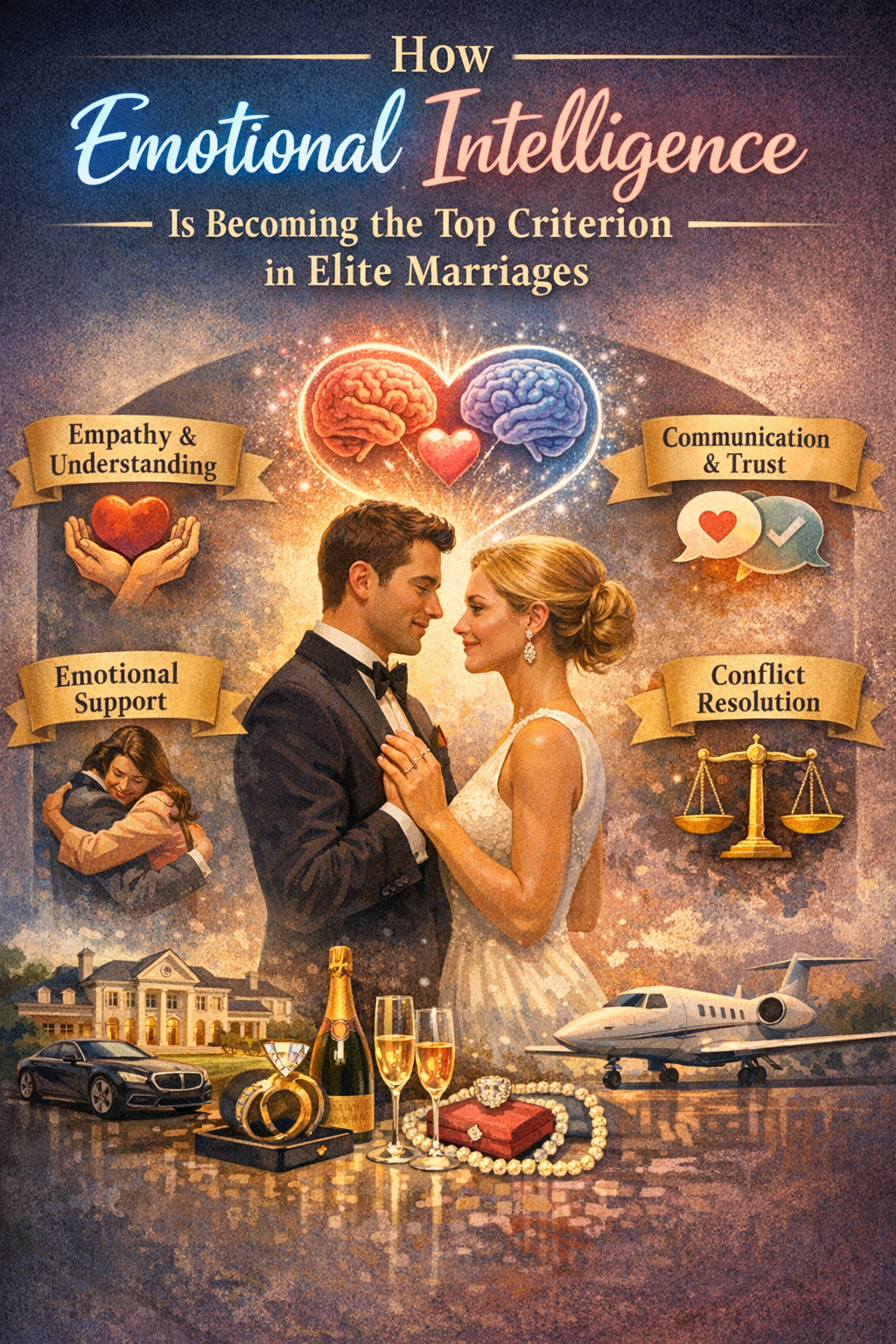
How Emotional Intelligence Is Becoming the Top Criterion in Elite Marriages
A Strategic Insight for Modern High-Profile Families
Introduction: A Quiet Revolution in Elite Marriage Decisions
For decades, elite marriages were evaluated through visible achievements:
- Prestigious degrees
- Established family reputation
- Financial strength
- Overseas settlement
- Social influence
In neighborhoods like Gulshan, Banani, and Baridhara, these factors once defined a “perfect match.”
But something fundamental has shifted.
Today, highly educated and socially respected families are prioritizing something far less visible yet far more powerful:
Emotional Intelligence (EQ).
Not just how much someone earns.
Not just where they studied.
Not just how influential their family is.
But how they manage emotions, handle conflict, communicate under pressure, and maintain respect.
Elite marriage is no longer about building an impressive alliance.
It is about building emotional stability.
And this shift is reshaping matchmaking standards across urban Bangladesh.
Understanding Emotional Intelligence in the Context of Marriage
Emotional Intelligence refers to the ability to:
- Recognize and regulate your own emotions
- Understand your partner’s emotional needs
- Communicate respectfully during disagreement
- Control ego-driven reactions
- Repair conflicts instead of escalating them
In marriage, EQ determines:
- How disagreements are handled
- Whether respect survives tension
- How families integrate
- Whether problems become solutions or scars
In elite marriages — where both individuals often have strong personalities, high education, and independent identities — emotional intelligence becomes even more critical.
Because when two powerful personalities unite, emotional maturity decides whether the union becomes strength or struggle.
Why Wealth and Education Are No Longer Enough
In upper-class communities, financial stability is usually already secured. Education levels are high. Social standing is established.
So why do conflicts still arise?
Because success does not automatically equal emotional maturity.
The Hidden Problem
Many high-achieving individuals:
- Are used to being right
- Rarely face rejection
- Operate in competitive environments
- Associate authority with dominance
Marriage, however, is not a competition.
It is collaboration.
Without emotional intelligence:
- Disagreements turn into power struggles
- Career success becomes ego leverage
- Communication turns defensive
- Small issues become identity conflicts
Elite families are beginning to understand this deeply.
The Shift in Elite Family Expectations
Today’s respected families in Dhaka increasingly ask:
- Is he emotionally stable?
- Can she handle disagreement without disrespect?
- Does he respect a career-oriented wife?
- Can she adjust without suppressing herself?
- Does he speak calmly under pressure?
These questions were rare ten years ago.
Now they are central.
Because families have witnessed a pattern:
Highly impressive matches collapsing due to emotional immaturity.
Emotional Intelligence vs. Intelligence (IQ)
High IQ may help someone:
- Excel academically
- Run a successful business
- Lead organizations
- Solve technical problems
But high EQ helps someone:
- Maintain harmony
- Resolve conflict
- Protect respect
- Build emotional safety
In marriage, the second matters more.
Being intelligent helps you build wealth.
Being emotionally intelligent helps you protect peace.
Dual-Career Marriages and Emotional Pressure
In elite areas like Gulshan and Banani, many couples are:
- Doctors
- Corporate executives
- Entrepreneurs
- NRB professionals
- Bankers
Dual-career marriages create:
- Time pressure
- Stress accumulation
- Emotional exhaustion
- Decision fatigue
Without EQ, stress spills into the relationship.
Common outcomes include:
- Short temper
- Withdrawal
- Silent resentment
- Blame culture
Emotionally intelligent partners, however:
- Separate work stress from personal interaction
- Communicate needs without accusation
- Offer support without control
They protect the relationship from external pressure.
The Silent Divorce Phenomenon
In elite families, divorce is often discreet.
Instead of public separation, couples may:
- Live under one roof but emotionally disconnected
- Avoid communication
- Maintain appearances for reputation
- Suppress dissatisfaction
This silent disconnection is frequently caused by:
- Chronic ego battles
- Lack of emotional validation
- Repeated unresolved conflict
- Emotional neglect
Low EQ sustains silent suffering.
High EQ prevents it by encouraging early dialogue and emotional repair.
Emotional Intelligence as a Screening Standard
Modern professional matchmaking is evolving.
Beyond biodata and income verification, attention is now given to:
- Communication style
- Tone under pressure
- Reaction to sensitive questions
- Respect toward previous proposals
- Attitude toward in-laws
Because emotional patterns are predictors of marital stability.
Elite families are realizing that:
A calm communicator with moderate wealth may create a happier marriage than a wealthy individual with reactive temperament.
Signs of High Emotional Intelligence in a Proposal
When evaluating a potential match, emotional intelligence appears in subtle ways:
- Balanced Communication
Speaks confidently but not aggressively. - Respectful Language
Mentions family members positively. - Accountability
Can admit past mistakes. - Emotional Awareness
Understands stress triggers and coping mechanisms. - Ego Control
Does not dominate conversations.
These qualities often predict long-term harmony.
Why High Achievers Sometimes Struggle Emotionally
Elite professionals often face environments where:
- Performance defines worth
- Authority is rewarded
- Competition is constant
- Emotional vulnerability is discouraged
Over time, this can create:
- Defensive behavior
- Inflexibility
- Low tolerance for disagreement
- Emotional suppression
Marriage requires vulnerability — something competitive environments rarely encourage.
Thus, emotional intelligence must be consciously developed.
Global Exposure and Emotional Awareness
Many elite matches involve NRB or foreign-returned individuals from countries such as:
- United Kingdom
- United States
- Canada
Global exposure has increased awareness of:
- Mental health
- Communication therapy
- Boundary setting
- Emotional compatibility
These candidates often prioritize personality alignment over mere financial status.
This global influence is shaping elite marriage expectations in Bangladesh.
Emotional Intelligence in Second Marriages
Second marriages demand even higher emotional maturity because:
- There may be children involved
- Past trauma may exist
- Trust may be fragile
- Fear of repetition is strong
Emotionally intelligent individuals:
- Avoid projecting past wounds
- Do not compare partners
- Communicate insecurities honestly
- Rebuild trust patiently
Without EQ, history often repeats itself.
How Emotional Intelligence Protects Family Reputation
Elite marriages often represent more than two individuals.
They involve:
- Extended families
- Business networks
- Social influence
- Community perception
Low emotional intelligence can lead to:
- Public disputes
- Family division
- Social embarrassment
- Long-term resentment
High emotional intelligence ensures:
- Private resolution of issues
- Respectful disagreement
- Preservation of dignity
In high-society circles, emotional discipline is strategic.
The Psychological Advantage of High EQ Couples
Emotionally intelligent couples:
- Apologize without humiliation
- Express appreciation regularly
- Listen actively
- Avoid character attacks
- Resolve misunderstandings quickly
These behaviors create:
- Emotional security
- Trust
- Long-term satisfaction
Research globally supports that conflict style predicts divorce risk more than income level.
Elite families are internalizing this insight.
The Future of Elite Marriage Selection
The next evolution of matchmaking in areas like Gulshan and Banani may include:
- Personality compatibility assessment
- Pre-marital counseling sessions
- Value alignment discussions
- Emotional maturity interviews
- Behavioral observation during meetings
Marriage media services that understand psychological compatibility will lead the future.
Because modern elite families seek not just prestige — but peace.
Why Emotional Intelligence Is the New Luxury
Luxury once meant:
- Cars
- Property
- International degrees
- Social influence
Today, true luxury in marriage means:
- Emotional safety
- Calm communication
- Mutual respect
- Stable partnership
In a world full of pressure, peace is priceless.
And emotional intelligence builds that peace.
Final Reflection: Redefining “Perfect” in Elite Marriage
A perfect biodata may impress society.
But a peaceful home sustains life.
Elite families are slowly redefining what “perfect” means.
Not flawless achievements.
Not exaggerated status.
Not visible wealth alone.
But emotional maturity.
Because at the end of the day:
- Degrees do not resolve conflict.
- Income does not guarantee empathy.
- Reputation does not ensure kindness.
Only emotional intelligence protects love, respect, and dignity over decades.
In the evolving landscape of elite marriages in urban Bangladesh, emotional intelligence has become the decisive factor.
It reduces ego battles.
It protects family reputation.
It prevents silent divorce.
It ensures mutual growth.
The most successful marriages today are not those built on display — but those built on emotional depth.
As elite families continue to learn from past patterns, one truth is becoming clear:
Emotional Intelligence is no longer optional.
It is the foundation of lasting elite marriage.
How Emotional Intelligence Is Becoming the Top Criterion in Elite Marriages (Extended Edition)

Advanced Analysis for Modern Elite Families
The Emotional Evolution of Marriage in Urban Bangladesh
Over the last decade, marriage dynamics in elite urban communities have undergone a silent transformation. In places like Gulshan, Banani, and Baridhara, marriage conversations are no longer limited to:
- Salary packages
- Academic degrees
- Family business scale
- Overseas citizenship
Instead, a new question is quietly dominating serious discussions:
“Is this person emotionally mature enough for lifelong partnership?”
This shift did not happen overnight. It is the result of accumulated experiences — successful marriages, failed alliances, silent separations, and lessons learned across elite families.
Emotional intelligence has moved from being a “nice-to-have” quality to becoming a core eligibility criterion.
Why Elite Marriages Face Unique Emotional Challenges
Elite marriages are fundamentally different from middle-income or traditional rural arrangements because they involve:
- Two strong individual identities
- Financial independence on both sides
- Public visibility
- Reputation management
- Complex family structures
When two high-functioning individuals come together, ego clashes are more likely unless emotional intelligence acts as a balancing force.
The Power Equation
In many elite marriages:
- The wife may be highly educated and financially independent.
- The husband may hold a powerful corporate or entrepreneurial position.
- Both families may have social influence.
Without emotional maturity, questions like these arise:
- Who makes the final decision?
- Whose career takes priority?
- How much involvement should in-laws have?
- Who controls financial planning?
If these issues are handled without emotional intelligence, conflict becomes inevitable.
Emotional Intelligence as Conflict Insurance
Think of emotional intelligence as insurance against escalation.
Every marriage will face:
- Misunderstandings
- Stress
- Financial disagreements
- Parenting differences
- Lifestyle conflicts
The difference between divorce and durability often lies not in the problem — but in how the problem is handled.
Emotionally intelligent couples:
- Avoid humiliation during arguments
- Stay solution-oriented
- Maintain respect even in anger
- Take responsibility for their role
This is why elite families now ask deeper questions during proposal evaluation.
The Psychological Profile of High-EQ Individuals
High emotional intelligence is visible in behavior patterns such as:
- Calm Under Criticism
They do not react defensively immediately. - Constructive Disagreement
They focus on solving the issue, not attacking the person. - Emotional Vocabulary
They can express feelings clearly instead of suppressing or exploding. - Empathy
They genuinely try to understand the partner’s perspective. - Boundary Awareness
They respect personal space and individuality.
These traits predict relationship longevity more accurately than income brackets.
The Ego Factor in Elite Marriages
One of the biggest silent threats in elite marriage is ego.
Highly accomplished individuals often:
- Tie self-worth to achievement
- Resist being corrected
- Feel threatened by equally strong partners
- Struggle with compromise
In marriage, ego transforms simple issues into power contests.
Example:
A discussion about where to live can turn into:
- “Whose family is more important?”
- “Whose career matters more?”
- “Who sacrificed more?”
Without emotional intelligence, ego wins — and intimacy loses.
Emotional Intelligence and Financial Transparency
Elite marriages often involve:
- Joint investments
- Business partnerships
- Asset planning
- International transfers
Money conversations can become emotionally charged.
Emotionally intelligent partners:
- Discuss financial expectations openly
- Avoid secrecy
- Respect financial independence
- Plan collaboratively
Low emotional intelligence leads to:
- Hidden accounts
- Suspicion
- Control dynamics
- Financial manipulation
Trust requires emotional maturity.
Social Media, Image, and Emotional Maturity
In high-society communities, image matters.
But emotional intelligence ensures:
- Public image does not override private peace
- Social validation does not replace real connection
- Comparison does not breed resentment
Without EQ:
- Couples compete over social presentation
- Jealousy over lifestyle display increases
- External validation becomes addictive
Emotionally mature individuals understand that real stability is internal, not performative.
Parenting Decisions in Elite Marriages
Parenting philosophies often differ in elite households.
Common differences include:
- International schooling vs. local elite schools
- Strict discipline vs. liberal upbringing
- Cultural preservation vs. global exposure
In cities like Dhaka, these discussions are becoming more frequent.
Emotionally intelligent couples:
- Discuss parenting values early
- Compromise respectfully
- Avoid undermining each other in front of children
Low EQ couples:
- Compete for authority
- Publicly criticize each other
- Create emotional insecurity for children
Marriage stability influences the next generation’s mental health.
Emotional Intelligence and In-Law Dynamics
Elite families often maintain close intergenerational ties.
Without emotional intelligence:
- Misinterpretation grows
- Small comments feel insulting
- Boundaries become battlegrounds
High EQ allows:
- Respectful distance
- Gratitude without dependency
- Calm communication during tension
In extended family systems, emotional maturity is non-negotiable.
The Increasing Role of Pre-Marital Conversations
Modern elite couples now discuss:
- Career continuation after children
- Living arrangements
- Financial responsibilities
- Religious practices
- Social boundaries
These discussions require emotional intelligence.
If handled with ego or impatience, they create fear and defensiveness.
If handled calmly, they build clarity and security.
Emotional Intelligence in Cross-Cultural Marriages
When one partner is foreign-returned from countries like:
- United Kingdom
- United States
- Canada
Cultural expectations may differ significantly.
Examples:
- Gender role flexibility
- Individualism vs. collectivism
- Emotional openness
Without EQ:
- Cultural misunderstanding escalates
- Traditional vs. modern conflict intensifies
With EQ:
- Differences become strengths
- Communication bridges expectations
Emotional Burnout in High-Pressure Marriages
Elite professionals face:
- Long working hours
- Travel commitments
- Social obligations
- High performance standards
Emotional intelligence helps couples:
- Recognize burnout signs
- Offer support without judgment
- Prioritize relationship time
- Avoid emotional neglect
Low EQ leads to:
- Emotional isolation
- Cold communication
- Feeling unappreciated
Burnout unmanaged can damage intimacy permanently.
Gender Expectations and Emotional Maturity
In elite communities, gender roles are evolving.
Modern educated women expect:
- Respect for career
- Emotional partnership
- Equal decision-making
Modern educated men expect:
- Emotional support
- Stability
- Mutual respect
Without emotional intelligence:
- Traditional expectations clash with modern identity
- Resentment builds
- Role confusion intensifies
High EQ allows flexibility and collaboration.
The Role of Self-Awareness Before Marriage
Emotional intelligence begins with self-awareness.
Questions every elite candidate should ask:
- Do I handle criticism well?
- Do I shut down during conflict?
- Do I become aggressive when stressed?
- Do I listen fully before responding?
- Can I apologize sincerely?
Marriage magnifies personality traits.
Self-awareness prevents future regret.
Emotional Intelligence as a Long-Term Investment
Elite families understand investment.
They evaluate:
- Property growth
- Business potential
- Financial risk
Now, emotional intelligence is seen as:
- A long-term stability investment
- A conflict-reduction mechanism
- A family harmony safeguard
Because divorce — especially in elite circles — has:
- Emotional cost
- Financial cost
- Reputation cost
Preventative emotional maturity is wiser than post-conflict damage control.
Emotional Intelligence in Second and Mature-Age Marriages
In marriages after 30 or 35:
- Individual identity is stronger
- Habits are established
- Flexibility may decrease
Thus, emotional intelligence becomes even more critical.
Mature individuals must:
- Negotiate routines
- Respect independence
- Avoid dominance
Without EQ, adjustment becomes resistance.
Why Emotional Intelligence Creates Attraction
Interestingly, emotional intelligence increases romantic attraction in the long term.
Qualities like:
- Calm confidence
- Emotional steadiness
- Respectful communication
- Empathy
Create:
- Safety
- Admiration
- Deep trust
Physical attraction may initiate interest.
Emotional maturity sustains it.
Emotional Intelligence and Power Balance
Power imbalance destroys marriages.
Emotionally intelligent couples:
- Share decision-making
- Avoid financial control tactics
- Encourage growth
Low EQ couples:
- Use success as leverage
- Compete instead of cooperate
- Create silent resentment
Power shared builds intimacy.
Power imposed builds distance.
The Psychological Safety Factor
Psychological safety means:
“I can express myself without fear of humiliation.”
High EQ marriages create this safety.
Partners feel:
- Heard
- Respected
- Valued
Without safety:
- Silence increases
- Vulnerability decreases
- Emotional withdrawal begins
Safety is the foundation of lifelong partnership.
Long-Term Impact of Emotional Intelligence on Children
Children raised in high-EQ households learn:
- Conflict resolution
- Respectful communication
- Emotional regulation
Children raised in low-EQ households may learn:
- Aggression
- Suppression
- Anxiety
Thus, emotional intelligence impacts generational stability.
The Future of Elite Matchmaking
Elite matchmaking is evolving toward:
- Psychological compatibility assessment
- Behavioral interviews
- Emotional maturity evaluation
- Pre-marital counseling recommendations
Marriage is being treated not just as a social contract — but as a psychological partnership.
Final Insight: Redefining Elite Standards
Elite once meant:
- Power
- Wealth
- Prestige
Now, elite marriage means:
- Emotional discipline
- Calm communication
- Respectful negotiation
- Stable partnership
The highest luxury today is not visible.
It is emotional security.
Closing Conclusion

Across Gulshan, Banani, and the wider Dhaka landscape, elite families are redefining what truly matters in marriage.
Emotional intelligence is no longer secondary.
It is central.
Because:
- Wealth can fluctuate.
- Status can change.
- Careers can shift.
But emotional maturity sustains respect, harmony, and dignity over decades.
In the modern era of elite marriages, emotional intelligence is not just a quality.
It is the ultimate foundation of lifelong success.