





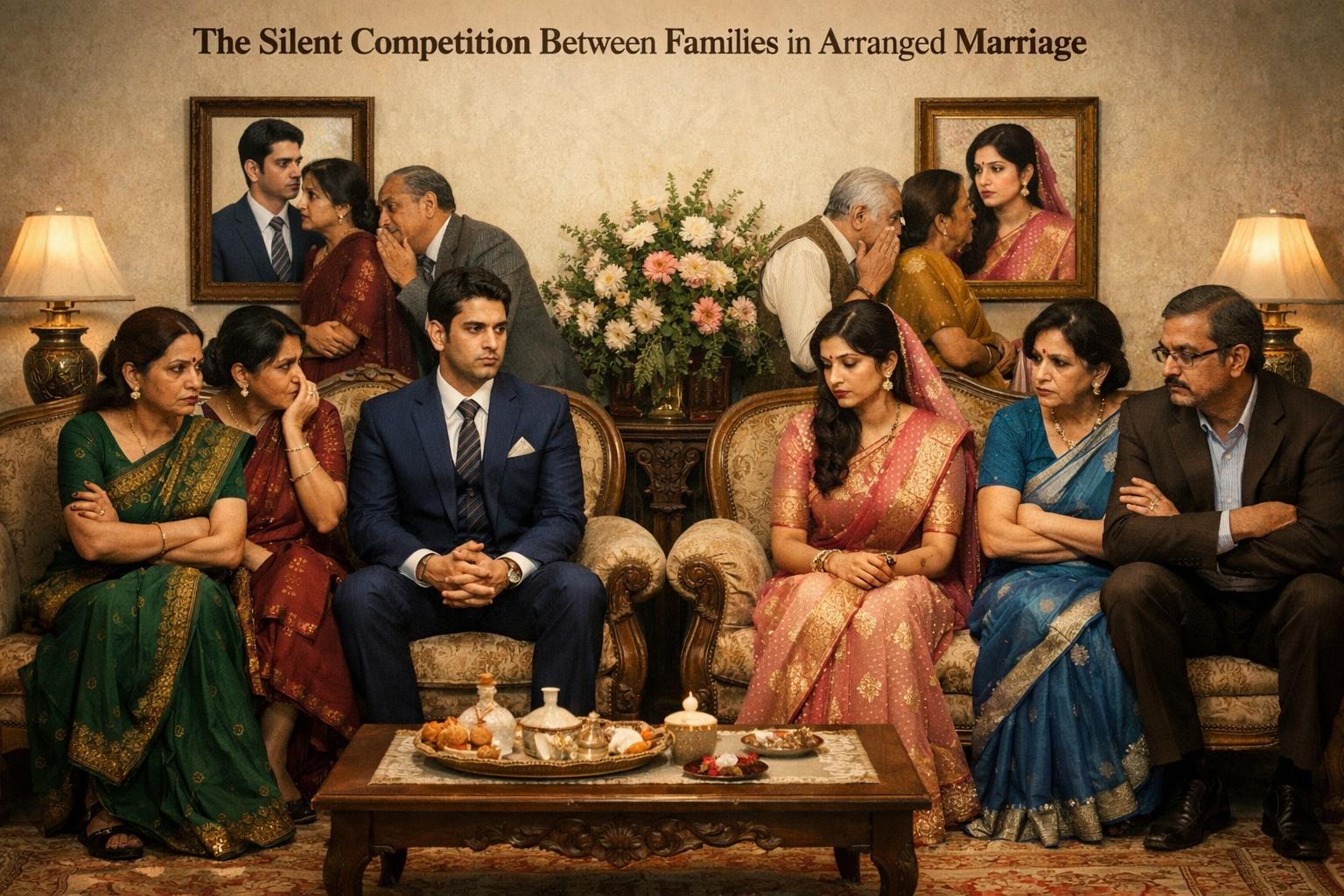
The Silent Competition Between Families in Arranged Marriage
Status, Ego, and the Invisible Pressure That Shapes Modern Matches
In many arranged marriages, especially within Dhaka’s elite neighborhoods like Gulshan, Banani, and Baridhara, the real tension is not always between the bride and groom.
It is often between the families.
Not openly.
Not loudly.
Not aggressively.
But silently.
There is a quiet competition that unfolds beneath polite smiles, carefully brewed tea, and respectful conversation. A competition about status. Education. Wealth. Reputation. Social standing. Even subtle displays of power.
And this silent rivalry shapes more marriage outcomes than most people are willing to admit.
This is the story of that invisible competition — how it begins, how it influences decisions, and why it quietly destroys many potentially beautiful marriages before they even start.
Arranged Marriage Is Not Just a Union of Two Individuals
In South Asian culture, marriage is rarely just about two people. It is about two families merging social, emotional, and economic ecosystems.
In neighborhoods like Gulshan and Banani, where families often carry generational wealth, corporate power, political influence, or social prestige, marriage becomes something larger than compatibility.
It becomes a reflection of family positioning.
A strategic alignment.
An unspoken negotiation of hierarchy.
When two families meet for an arranged proposal, they are not only evaluating the bride or groom. They are measuring each other.
- Who has the stronger financial background?
- Whose social circle is more influential?
- Whose children studied abroad?
- Who owns more property?
- Who has a cleaner public reputation?
No one says it aloud.
But everyone feels it.
The Beginning of Silent Comparison
The competition starts long before the first formal meeting.
It begins the moment one family receives a biodata or profile.
Instead of simply asking:
“Is this person kind? Mature? Compatible?”
The subconscious question becomes:
“Are they equal to us?”
Equality here rarely means emotional equality.
It means:
- Equal wealth
- Equal educational prestige
- Equal social visibility
- Equal family reputation
If there is even a small perceived imbalance, anxiety appears.
“What will people say?”
This question — more than compatibility — drives many acceptance or rejection decisions.
Education as a Status Battlefield
In elite circles, education becomes symbolic currency.
If one family’s son graduated from a foreign university and the other family’s daughter studied locally, subtle comparisons arise.
If one bride holds an MBA and the groom holds a master’s degree from abroad, relatives start calculating invisible points.
Education stops being about intellectual maturity.
It becomes about scoreboard value.
Families may not reject openly. But hesitation appears.
They say things like:
- “We will think about it.”
- “Let us review more options.”
- “We need to discuss internally.”
Often, the issue is not incompatibility.
It is competitive insecurity.
Financial Strength: The Quiet Power Game
Money introduces a more delicate layer of rivalry.
No one openly asks, “How much do you earn?”
But everyone tries to estimate.
- What car do they drive?
- Where do they live?
- What kind of wedding can they afford?
- How many businesses do they own?
- What kind of lifestyle do they maintain?
In areas like Baridhara, lifestyle becomes a visible indicator of status.
If one family appears slightly stronger financially, the other may feel intimidated.
If one appears slightly weaker, the stronger family may unconsciously dominate the tone of negotiation.
This imbalance creates tension long before marriage happens.
And often, the bride and groom themselves are unaware of it.
Reputation Anxiety in Elite Circles
Reputation in high-society areas spreads quickly.
One rumor can travel across social circles in days.
Families become hyper-aware of how alliances affect their image.
They ask:
- Does this family have any past controversy?
- Has there been divorce in the family?
- Are they politically connected?
- Is their business ethically clean?
Sometimes these concerns are valid.
But often, they are amplified by fear of social comparison.
Marriage becomes a branding decision.
And when marriage turns into brand management, emotional compatibility quietly loses importance.
The Role of Extended Relatives in Fueling Competition
Arranged marriage discussions rarely involve just parents.
Uncles, aunts, cousins, even distant relatives insert opinions.
And many of these opinions are driven by ego.
An aunt may say:
“We can find better.”
An uncle may say:
“They are not at our level.”
A cousin may whisper:
“Why should we compromise?”
Each comment intensifies the competitive lens.
Instead of asking, “Will our child be happy?”
The question becomes, “Are we lowering our standard?”
The difference between these two questions is enormous.
And it is the root of many broken negotiations.
When Weddings Become Power Displays
The silent competition does not end with proposal acceptance.
It often escalates during wedding planning.
- Who will host the bigger reception?
- Who will invite more influential guests?
- Who will arrange a more luxurious venue?
- Who will display greater generosity?
What should be a celebration of love transforms into a prestige contest.
And the bride and groom — the two people whose future is at stake — often feel overwhelmed by expectations that were never theirs.
The Emotional Cost for the Bride and Groom
This silent rivalry carries emotional consequences.
The couple begins to feel:
- Pressure to “represent” their family
- Fear of making mistakes
- Anxiety about performance
- Guilt if negotiations fail
Instead of entering marriage with emotional clarity, they enter with inherited tension.
Many engagement breakups in Dhaka happen not because of personal incompatibility — but because families could not resolve competitive insecurities.
Why Silent Competition Is More Dangerous Than Open Conflict
Open disagreement can be addressed.
Silent competition cannot.
Because it hides behind politeness.
It disguises itself as:
- “Practical concern”
- “Future security”
- “Family standard”
- “Social respect”
But underneath, it is often fear of losing status.
And fear-driven decisions rarely create stable marriages.
The Psychological Root of Family Rivalry
At its core, this competition stems from three deep fears:
- Fear of social downgrade
- Fear of being judged
- Fear of losing influence
In affluent areas like Dhaka, where social circles overlap tightly, status becomes fragile.
Families feel they must constantly maintain positioning.
Marriage becomes one of the most visible public statements of that positioning.
How Structured Matchmaking Reduces Silent Competition
Professional, confidential matchmaking services introduce a neutral ground.
When families meet through structured mediation:
- Financial expectations are clarified early
- Lifestyle compatibility is assessed objectively
- Reputation verification is handled discreetly
- Emotional maturity is evaluated before meetings
This reduces surprise comparisons.
It minimizes ego-driven rejection.
It shifts focus back to compatibility.
Because when discussions are guided professionally, competition loses its emotional intensity.
When Families Learn to Choose Peace Over Prestige
Not all elite families fall into rivalry traps.
Some consciously prioritize:
- Emotional intelligence over degrees
- Character over wealth
- Stability over showmanship
- Long-term compatibility over short-term status
These families often experience smoother negotiations.
Their children enter marriage with less pressure.
Their relationships begin with respect instead of comparison.
And ironically, they often gain more social respect because of their grounded decisions.
The Hidden Regret of Competitive Rejection
Years later, some families privately admit:
“We rejected good proposals because we were thinking too much about status.”
By the time they realize it, the compatible matches are gone.
The pool narrows.
Age increases.
Pressure intensifies.
And the silent competition that once felt protective becomes a source of regret.
Breaking the Cycle
To break silent competition, families must ask different questions:
Instead of:
“Are they equal to us?”
Ask:
“Will our children grow peacefully together?”
Instead of:
“What will society say?”
Ask:
“What will make them emotionally secure?”
Instead of:
“Are we upgrading or downgrading?”
Ask:
“Are we building stability?”
These subtle shifts transform the entire negotiation atmosphere.
The Future of Arranged Marriage in Elite Dhaka
The new generation is becoming more emotionally aware.
Many young professionals in Gulshan and Banani are requesting:
- Smaller meetings
- Less extended family involvement
- Clear financial discussions
- Private negotiations
They want marriage to feel like partnership, not competition.
As modern values merge with traditional frameworks, arranged marriage is evolving.
And in that evolution, silent family rivalry must slowly dissolve.
Final Reflection
The silent competition between families in arranged marriage is rarely malicious.
It is driven by fear.
Fear of judgment.
Fear of imbalance.
Fear of losing face.
But when fear leads, compatibility suffers.
The strongest marriages are not built on matched status.
They are built on matched emotional maturity.
When families choose dignity over dominance,
When they prioritize stability over spectacle,
When they allow their children’s happiness to outweigh social comparison —
The Silent Competition Between Families in Arranged Marriage (Extended Deep Analysis)
Power, Prestige, Insecurity, and the Invisible Negotiations That Shape Modern Marriages
In many arranged marriages within Dhaka’s affluent neighborhoods, something unspoken governs decisions.
It is not compatibility.
It is not love.
It is not even long-term stability.
It is comparison.
And comparison, when mixed with pride and social visibility, quietly becomes competition.
This competition rarely announces itself. There are no raised voices. No dramatic confrontations. Instead, it moves beneath courtesy. Beneath smiles. Beneath respectful greetings.
It lives in tone shifts, delayed responses, subtle remarks, and strategic pauses.
And yet — it has the power to break proposals, delay decisions, and create emotional scars that remain long after negotiations end.
Let us go deeper into the layers of this silent rivalry.
Status Matching vs Emotional Matching
In traditional arranged marriage structures, the idea of “matching families” has always existed. However, in modern elite areas such as Gulshan, Banani, and Baridhara, this matching has evolved into something far more complex.
Families no longer compare only culture and values.
They compare:
- Property portfolios
- Business networks
- Political proximity
- Educational pedigree
- Lifestyle aesthetics
- Social media presentation
Compatibility becomes secondary to symmetry.
But here is the psychological problem:
Status symmetry does not guarantee emotional harmony.
Two families may be perfectly aligned socially yet completely misaligned emotionally. And when emotional misalignment is ignored in favor of prestige balance, marriage begins on unstable ground.
The Fear of “Losing Face”
One of the strongest motivators behind silent competition is fear of losing face.
In tightly connected elite circles within Dhaka, reputation spreads quickly. Invitations overlap. Business interests intersect. Children attend the same schools. Families attend the same weddings.
Every marriage decision becomes a public statement.
If one family perceives even slight imbalance, they fear whispers:
- “They married below their level.”
- “They couldn’t secure a stronger match.”
- “Maybe their position isn’t as solid as we thought.”
Even if such gossip never occurs, the anticipation of it shapes decisions.
Ironically, many families reject stable, compatible proposals simply to protect an imagined perception.
And imagined perception often carries more weight than reality.
Subtle Dominance in Negotiation Rooms
Observe carefully during an arranged marriage meeting.
Dominance is rarely direct. It appears through:
- Who speaks first
- Who interrupts
- Who decides the next meeting
- Who sets the venue
- Who delays confirmation
Sometimes one family subtly asserts financial superiority through tone. Other times, educational prestige is highlighted indirectly.
Statements like:
- “Our son has international exposure.”
- “We come from a very respected lineage.”
- “We prefer certain standards.”
These phrases are not inherently problematic. But when used to assert hierarchy rather than share information, they introduce imbalance.
And imbalance invites insecurity.
Insecurity, in turn, invites competition.
The Wedding as a Stage of Power Projection
Once engagement is confirmed, another layer begins.
The wedding itself becomes an arena.
Who hosts the larger event?
Who arranges more elaborate décor?
Who gifts more visibly?
In some cases, families feel compelled to outdo each other to avoid appearing inferior.
What begins as celebration quietly transforms into performance.
This performance pressure can financially strain even wealthy families.
And yet, they comply.
Because prestige anxiety often outweighs financial logic.
The Psychological Toll on the Couple
Amid these silent comparisons, the bride and groom carry invisible burdens.
They feel:
- Pressure to uphold family image
- Fear of disappointing relatives
- Anxiety about fulfilling social expectations
- Emotional exhaustion before marriage even begins
When families compete, couples become symbolic representatives.
Instead of being individuals entering partnership, they become ambassadors of family status.
And this role is heavy.
Many newly married couples report tension not because of personal conflict — but because they are navigating inherited pride.
The Comparison Trap: When “Better Option” Syndrome Delays Marriage
Another dimension of silent competition is perpetual comparison.
Families often hesitate, believing:
“A slightly better proposal might come.”
Better meaning:
- Higher income
- Stronger surname
- Larger business
- More international exposure
This “upgrade mentality” turns marriage search into marketplace optimization.
But unlike business deals, marriage timing matters.
Compatibility pools narrow with age.
Emotional flexibility decreases.
Social pressure increases.
Families who continuously wait for a marginally superior match often realize — too late — that stability was more valuable than incremental prestige.
Divorce Anxiety and Reputation Management
In elite societies, divorce carries social implications.
Therefore, families sometimes compete to avoid perceived risk.
They over-analyze the other side’s family history.
They investigate distant relatives.
They interpret minor details as red flags.
While caution is wise, excessive scrutiny often hides competitive defensiveness.
The mindset becomes:
“If anything goes wrong, our image will suffer.”
This defensive posture can suffocate promising matches.
Generational Conflict Within the Same Family
Interestingly, silent competition does not only occur between two families.
It also exists within families.
Parents may prioritize status.
Children may prioritize emotional connection.
This internal tension creates negotiation delays.
In modern Dhaka, many educated professionals desire balanced, emotionally intelligent partners. But parents, influenced by social positioning, may insist on equal or superior status alliances.
When these priorities clash, proposals stagnate.
And sometimes, children feel trapped between personal happiness and parental pride.
Social Media: The New Comparison Amplifier
Today, competition is no longer confined to drawing rooms.
Social media amplifies perception.
Families observe:
- Vacation destinations
- Wedding aesthetics
- Luxury purchases
- Business announcements
Even before meeting, they form assumptions.
Comparison intensifies digitally.
Marriage discussions now occur in an era where curated online personas influence offline judgments.
This digital visibility heightens competitive tension.
When Humility Wins
Despite all these complexities, some families break the cycle.
They consciously choose humility.
They focus on:
- Emotional maturity
- Shared life goals
- Conflict resolution style
- Financial transparency
- Mutual respect
These families often experience smoother negotiations and stronger post-marriage relationships.
They understand something crucial:
Status may attract admiration.
But stability builds legacy.
The Economics of Ego
Silent competition carries financial consequences.
Lavish weddings, excessive gifts, unnecessary displays — these are often ego-driven expenses.
Families justify them as tradition.
But frequently, they are prestige signaling mechanisms.
Ironically, financial overextension during marriage sometimes seeds future marital tension.
When ego dictates spending, emotional security often suffers.
Power Balance and Long-Term Marriage Stability
When marriage begins with competitive imbalance, power struggles may continue afterward.
If one family felt superior during negotiation, that hierarchy can influence:
- Decision-making
- Conflict mediation
- Financial discussions
- Living arrangements
Balanced negotiations create balanced marriages.
Imbalanced negotiations often create silent resentment.
And resentment rarely disappears — it transforms.
The Quiet Regret of Missed Compatibility
Years later, some families privately reflect.
They remember proposals they rejected due to subtle status concerns.
They realize:
The person was kind.
The families were respectful.
The compatibility was strong.
But pride intervened.
And pride rarely announces regret publicly.
It remains silent — just like the competition that caused it.
The Role of Confidential Matchmaking in Reducing Rivalry
Structured, discreet matchmaking services often minimize direct competitive friction.
Why?
Because:
- Financial expectations are clarified privately
- Compatibility is assessed before meetings
- Social mismatches are filtered early
- Negotiations are guided neutrally
When discussions are structured, emotional ego is less likely to dominate.
Professional mediation transforms rivalry into rational dialogue.
The Cultural Evolution of Arranged Marriage
Arranged marriage in Dhaka is evolving.
Younger generations increasingly value:
- Emotional intelligence
- Shared values
- Psychological safety
- Partnership equality
Families who adapt to this evolution experience less competitive anxiety.
Because when focus shifts from prestige to partnership, rivalry loses relevance.
The Three Silent Questions That Define Outcomes
Every family, consciously or unconsciously, answers three questions:
- Are we gaining status or losing it?
- Will society approve?
- Are we comfortable appearing equal — or superior?
When these questions dominate, compatibility fades.
But when families replace them with:
- Are our children emotionally secure?
- Do they respect each other?
- Can they build stability together?
The entire tone of negotiation transforms.
Breaking the Competitive Pattern
To break silent competition, families must cultivate:
- Self-awareness
- Emotional security
- Long-term thinking
- Detachment from social comparison
It requires courage to choose peace over prestige.
But peace sustains marriage.
Prestige does not.
Final Reflection: Beyond Status, Toward Stability
The silent competition between families in arranged marriage is not inherently malicious.
It is born from insecurity, pride, and fear of judgment.
But when these forces dictate decisions, they compromise emotional foundations.
Marriage is not a merger of brands.
It is a union of two evolving individuals.
When families learn to prioritize emotional alignment over social symmetry, arranged marriage regains its strength.
Not as a battlefield of prestige.
But as a bridge of stability.
And in the end, stability is the only status that truly matters.