






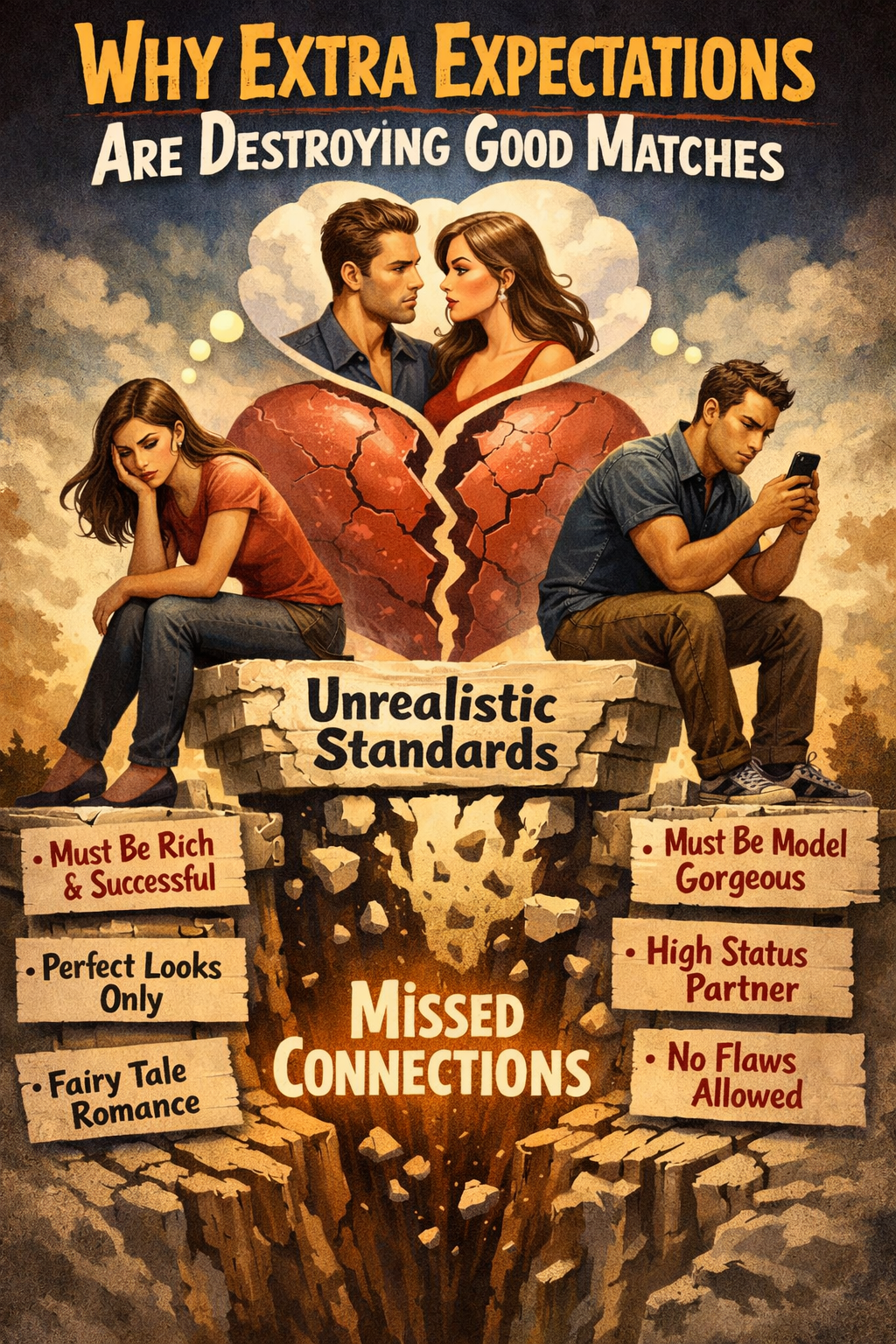
Why Extra Expectations Are Destroying Good Matches

In today’s marriage market, something subtle yet powerful is happening.
Good proposals are coming.
Educated families are meeting.
Successful individuals are connecting.
And yet…
The match doesn’t move forward.
Not because of incompatibility.
Not because of red flags.
Not because of major differences.
But because of something smaller.
Something quieter.
Something more socially acceptable.
Extra expectations.
And slowly, silently, these extra expectations are destroying perfectly good matches.
When “Standards” Become “Barriers”
There is nothing wrong with having standards.
In fact, standards protect you from poor decisions.
Wanting:
- Education
- Stability
- Respectable family
- Good character
- Emotional maturity
— these are healthy expectations.
But there is a thin line between standards and excess.
Standards protect compatibility.
Excess protects ego.
And when ego begins leading the process, good matches quietly disappear.
The Modern Checklist Explosion
Marriage conversations today often begin with checklists:
Height requirement.
Income minimum.
Specific profession.
Specific university.
Specific location.
Specific social exposure.
Specific lifestyle habits.
Each requirement may seem reasonable on its own.
But combined together, they create a narrow tunnel.
And sometimes, no human being can realistically fit inside that tunnel perfectly.
Good proposals fail not because they are unsuitable — but because they miss one or two minor boxes.
And those minor boxes become deal-breakers.
The Illusion of “If I Can Get Better, Why Settle?”
In urban elite circles, options are abundant.
Multiple proposals.
Multiple networks.
Online platforms.
Professional matchmakers.
When options increase, expectations rise.
People begin thinking:
“If this one is good, maybe the next one will be better.”
This “upgrade mentality” turns marriage into comparison shopping.
But relationships are not products.
They are partnerships.
And partnership thrives on alignment — not optimization.
Social Comparison Is Fueling Unrealistic Demands
We live in a comparison culture.
A friend marries a foreign graduate.
A cousin marries into a business empire.
A colleague marries someone with dual citizenship.
Suddenly, your perfectly good proposal feels “average.”
Not because it is lacking.
But because someone else’s looks slightly more glamorous.
Comparison distorts perception.
And distorted perception makes reasonable expectations feel insufficient.
Financial Expectations: Stability vs Status
Financial security is important in marriage.
But today, financial expectation has quietly shifted from stability to status.
Instead of asking:
“Can this person provide a comfortable life?”
Families now ask:
“Does this person match our social image?”
Salary differences of minor amounts become major issues.
Property ownership becomes mandatory.
Business scale becomes a ranking factor.
Good matches fail over minor financial gaps — even when both sides are financially secure.
When status replaces stability as the priority, compatibility suffers.
The Education Obsession
Education matters.
But education is not the same as emotional intelligence.
In elite environments, families often filter heavily by:
- Specific universities
- Foreign degrees
- Ranking of institutions
Two people may share values, communication style, and life goals.
But one studied locally, and the other abroad.
And that single difference blocks the match.
When degrees outweigh character, priorities become misaligned.
Height, Appearance, and the Aesthetic Standard
Physical attraction matters.
But aesthetic perfection does not guarantee emotional safety.
Sometimes a match fails because:
“He is two inches shorter than ideal.”
“She doesn’t fit the exact beauty standard imagined.”
Minor physical differences overshadow major compatibility strengths.
And later, those who reject based on appearance sometimes realize:
Peace matters more than perfection.
The Lifestyle Inflation Problem
As society becomes more urban and elite-focused, lifestyle expectations expand.
Travel frequency.
Dining habits.
Car brands.
Residential zones.
Social event participation.
People expect a partner who seamlessly fits into their exact lifestyle.
But lifestyle is adaptable.
Values are not.
When lifestyle alignment becomes more important than value alignment, good matches collapse.
The Ego of “We Deserve the Best”
Parents often say:
“Our son/daughter deserves the best.”
And they are right.
But what does “best” mean?
Does it mean:
- Highest salary?
- Most prestigious family?
- Most socially impressive background?
Or does it mean:
- Emotional safety?
- Respect?
- Long-term compatibility?
Sometimes in protecting children from compromise, families unintentionally protect them from marriage.
Micro-Rejections Are Increasing
In today’s marriage environment, proposals often end due to micro-reasons:
- Slight difference in accent.
- Slight variation in religious practice.
- Slight family culture mismatch.
- Slight career difference.
None of these are serious incompatibilities.
But accumulated together, they create rejection patterns.
And the individual remains unmarried — not because no good proposal came, but because no proposal met perfection.
The Hidden Fear Behind Extra Expectations
Extra expectations often mask fear.
Fear of regret.
Fear of judgment.
Fear of choosing “wrong.”
Fear of social comparison.
Instead of admitting fear, people raise standards.
It feels safer to reject than to commit.
Because commitment requires vulnerability.
And vulnerability feels risky.
The Decision Paralysis Cycle
Here’s how excessive expectation usually plays out:
- Proposal arrives.
- Initial interest forms.
- Minor imperfection is noticed.
- Doubt grows.
- Comparison begins.
- Decision delays.
- Emotional excitement fades.
- Proposal ends.
This cycle repeats.
Each time, expectations grow slightly higher.
Each time, decision confidence decreases.
Emotional Compatibility Is Being Undervalued
In many rejected matches, emotional compatibility existed.
They could talk comfortably.
They shared humor.
They respected each other.
But because one measurable metric was slightly below expectation, the proposal ended.
Emotional safety is invisible.
And invisible qualities are often undervalued.
Until later in life.
Marriage Is Not a Social Trophy
Some families treat marriage as a status announcement.
The wedding becomes a public display of alliance.
But marriage is not an award ceremony.
It is a daily partnership.
The person you choose will not be judged only at the wedding.
They will sit with you during stress.
During illness.
During career shifts.
During family conflicts.
And in those moments, emotional maturity matters more than social image.
Why Extra Expectations Increase with Age
Interestingly, expectations often grow with time.
As someone reaches their 30s, they think:
“I have waited this long. Now it must be extraordinary.”
So they raise standards further.
But time passing does not increase compatibility options.
It reduces flexibility.
Because personality patterns become more rigid.
Waiting for extraordinary sometimes blocks perfectly suitable.
The Over-Filtering Family Trap
Sometimes the individual is ready.
But the family filters excessively.
They analyze:
- Distant relatives.
- Financial history generations back.
- Social connections.
- Extended family reputations.
Caution is wise.
But excessive scrutiny can eliminate good matches unnecessarily.
Balance is crucial.
The Myth of 100% Satisfaction
No marriage offers 100% checklist satisfaction.
Every match includes:
- Minor compromises.
- Slight differences.
- Personality contrasts.
- Lifestyle adjustments.
Those who seek total perfection often remain in search mode.
Because total perfection does not exist.
Good Matches Often Feel “Calm,” Not “Exciting”
Another hidden issue:
Healthy compatibility often feels calm.
Not dramatic.
Not intense.
Not overwhelming.
But many people mistake calm for boring.
They expect spark, intensity, cinematic clarity.
In reality, long-term marriages thrive on stability — not fireworks.
Professional Matchmaking as Expectation Alignment
Structured matchmaking environments help families:
- Differentiate between standards and ego.
- Separate essential from non-essential.
- Identify fear-driven rejection.
- Encourage thoughtful decision-making.
- Protect good matches from unnecessary collapse.
Sometimes, people do not need better proposals.
They need clearer priorities.
The Cost of Excess
What is the cost of extra expectations?
Lost time.
Emotional fatigue.
Increased pressure.
Reduced flexibility.
Decreased optimism.
Eventually, even strong individuals feel discouraged.
And ironically, they may later accept proposals they would have rejected earlier — only under greater pressure.
A Healthier Framework for Expectations
Instead of asking:
“Is this person extraordinary in every category?”
Ask:
- Do we share values?
- Do we respect each other?
- Can we communicate openly?
- Can we handle conflict maturely?
- Can we grow together?
If the answer is yes, minor imperfections become manageable.
The Courage to Choose
Marriage requires decision courage.
At some point, searching must end.
Evaluation must transition into commitment.
Without courage, expectation becomes endless.
And endless expectation destroys momentum.
Final Reflection: Expectations Should Guide, Not Control
Expectations are healthy when they protect you.
They are destructive when they dominate you.
Good matches are being lost every day — not due to incompatibility — but due to excess.
Because sometimes, “slightly imperfect” is perfectly suitable.
And those who understand this find peace earlier.
Those who don’t continue searching.
When Expectations Become Identity
At a certain point, expectations stop being preferences.
They become identity.
Families begin to say:
“This is who we are.”
“This is our standard.”
“This is our level.”
And once expectations become part of identity, lowering them feels like lowering self-worth.
But here is the uncomfortable truth:
Marriage is not a reflection of ego.
It is a reflection of partnership capacity.
When expectations are tied to pride instead of practicality, they stop protecting you — and start isolating you.
The Subtle Power of Social Pressure in Elite Circles
In upper-class communities, everything is quietly competitive.
Education.
Business scale.
Property ownership.
Wedding grandeur.
Marriage becomes another benchmark.
Families fear subtle judgment:
“What will people say if we choose this proposal?”
“Is this match impressive enough?”
“Will relatives compare?”
So they reject good matches — not because of incompatibility — but because of social optics.
The tragedy is this:
Society comments for a week.
But marriage lasts a lifetime.
The “Upgrade Mentality” Is Endless
One of the most damaging patterns in modern matchmaking is upgrade thinking.
If someone is:
- Good-looking — maybe someone more attractive exists.
- Financially stable — maybe someone wealthier exists.
- Respectable — maybe someone more prestigious exists.
The search for “slightly better” has no finish line.
Because human comparison always finds something missing.
This mindset converts marriage into continuous evaluation instead of emotional investment.
And when evaluation never ends, commitment never begins.
Why Minor Differences Feel Major
In many rejected proposals, the differences are small.
- A different school background.
- Slightly different neighborhood.
- Slightly different accent.
- Slight difference in salary.
But why do small differences feel so large?
Because when expectations are inflated, tolerance shrinks.
The higher the expectation bar, the less room there is for humanity.
And humanity includes imperfection.
The Emotional Cost of Perfectionism
Perfectionism may feel empowering.
But emotionally, it is exhausting.
Constant filtering.
Constant evaluation.
Constant comparison.
After years of this, many individuals feel:
- Mentally drained.
- Emotionally skeptical.
- Less optimistic about marriage.
Extra expectations don’t just destroy matches.
They erode emotional energy.
And eventually, even good proposals fail because enthusiasm is gone.
When Families Confuse Protection with Control
Parents want to protect their children.
This is natural.
But sometimes protection becomes control.
They overanalyze:
- Extended family income.
- Property valuation.
- Business ranking.
- Social influence circles.
Instead of asking:
“Is this person kind?”
They ask:
“How strong is their family brand?”
Brand value cannot replace character.
But brand often overshadows character in elite filtering.
And good matches disappear quietly.
The Fear of Regret Disguised as High Standards
Many individuals raise expectations not because they are arrogant — but because they fear regret.
They think:
“If I compromise even slightly, I might regret it later.”
But compromise in marriage is not weakness.
It is balance.
There is a difference between sacrificing values and adjusting preferences.
When someone confuses the two, they reject reasonable proposals.
The Illusion That More Time Equals Better Options
Some believe:
“If I wait longer, something better will come.”
But time does not automatically improve options.
What often happens instead:
- Personal flexibility decreases.
- Social pressure increases.
- Family anxiety rises.
- Emotional readiness fluctuates.
Waiting for perfection may reduce the pool of realistic compatibility.
And by the time clarity arrives, exhaustion replaces excitement.
Emotional Intelligence Is Being Ignored
Many proposals fail due to surface-level metrics.
But emotional intelligence rarely appears in biodata.
Qualities like:
- Listening skills.
- Conflict resolution.
- Respectful communication.
- Patience during disagreement.
These qualities build stable marriages.
But they are invisible during checklist evaluation.
So people reject emotionally safe matches — in pursuit of socially impressive ones.
The Ego of “We Can Do Better”
Sometimes families say, “We can do better.”
This belief may come from:
- Financial strength.
- Social influence.
- Strong network.
But better is subjective.
Better in what sense?
Wealth?
Status?
Appearance?
Or emotional partnership?
When “better” becomes abstract, it becomes infinite.
And infinite standards block finite opportunities.
The Delayed Realization Pattern
Many people realize too late that they rejected good matches for minor reasons.
Years later, they think:
“That proposal was actually stable.”
“That person was respectful.”
“That family was genuine.”
But by then, the opportunity has passed.
Expectation clarity often comes with experience.
But marriage decisions happen in the present.
The Danger of Matching Only on Status
Status compatibility feels safe.
Same social circle.
Same exposure.
Same financial level.
But status similarity does not guarantee emotional maturity.
Two highly ambitious individuals may clash.
Two dominant personalities may struggle for control.
Two perfectionists may exhaust each other.
Without humility, equality turns into competition.
The Hidden Anxiety of Public Image
In elite families, image management is constant.
So marriage becomes another performance stage.
People worry about:
- Wedding scale.
- Guest list quality.
- Social commentary.
- Reputation alignment.
But once the wedding is over, real life begins.
And real life requires adaptability — not audience approval.
How Extra Expectations Affect Men and Women Differently
For men, expectations often center around:
- Beauty standards.
- Social grace.
- Education.
- Family background.
For women, expectations often center around:
- Financial stability.
- Professional status.
- Property ownership.
- Global exposure.
Both sides increase demands.
And when both increase simultaneously, the overlap shrinks.
Fewer matches survive.
The Psychological Weight of “Ideal Age”
As individuals grow older, they feel:
“I have waited this long, now it must be exceptional.”
But time increases emotional caution.
Caution increases expectation.
Expectation reduces flexibility.
And reduced flexibility reduces matches.
It becomes a cycle.
The Fear of Vulnerability
At the core of excessive expectations lies vulnerability fear.
Choosing someone means:
- Allowing emotional exposure.
- Trusting another person.
- Accepting uncertainty.
Rejection feels safer than commitment.
So people create extra filters to delay decision.
Because as long as they are searching, they are not vulnerable.
The Shift from Evaluation to Vision
Healthy marriage decisions require vision.
Not just evaluation.
Instead of asking:
“What is missing?”
Ask:
“What can we build together?”
Vision focuses on growth.
Evaluation focuses on gaps.
And gap-focused thinking destroys momentum.
The Marriage Market Is Not a Corporate Merger
In elite circles, marriage sometimes resembles strategic alliance.
Business background meets business background.
Influence meets influence.
But marriage is not corporate expansion.
It is daily partnership.
If emotional alignment is missing, no strategic alignment can compensate.
When Good Matches Feel “Too Simple”
Sometimes a proposal is straightforward.
Respectful family.
Stable career.
Good character.
But no dramatic story.
And because it feels simple, families think:
“Maybe we can find something more impressive.”
But simple stability often builds the strongest marriages.
Drama excites temporarily.
Stability sustains permanently.
Why Expectation Inflation Increases After Success
The more successful someone becomes, the more they feel entitled to an exceptional match.
This is natural.
But entitlement can cloud realism.
Success in career does not automatically entitle perfection in partnership.
Marriage is not reward.
It is collaboration.
The Courage to Redefine “Best”
The real shift happens when someone redefines best.
Best is not:
- Highest income.
- Most prestigious background.
- Most admired social circle.
Best is:
- Emotional security.
- Mutual respect.
- Shared values.
- Long-term compatibility.
Once this shift happens, expectations become realistic.
And realistic expectations create successful matches.
A Hard Truth About Extra Expectations
Extra expectations feel empowering in the short term.
They create control.
They create superiority.
They create filtering power.
But in the long term, they create isolation.
Because the higher the wall, the fewer people can reach you.
The Balance Between Standards and Flexibility

Destroying
Healthy matchmaking requires balance:
Firm on values.
Flexible on preferences.
Non-negotiable:
- Character.
- Integrity.
- Respect.
- Life direction.
Negotiable:
- Minor lifestyle differences.
- Slight financial gaps.
- Educational background differences.
- Personality contrasts.
When negotiables become non-negotiable, good matches collapse.
Final Reflection: Expectations Should Protect Peace — Not Protect Pride
At the end of the day, marriage is not about impressing society.
It is about building peace.
Extra expectations often protect pride.
But pride does not create companionship.
Peace does.
And sometimes, the match that looks 90% ideal may bring 100% emotional stability.
But only if given a chance.